What Are Hybrid Bearings
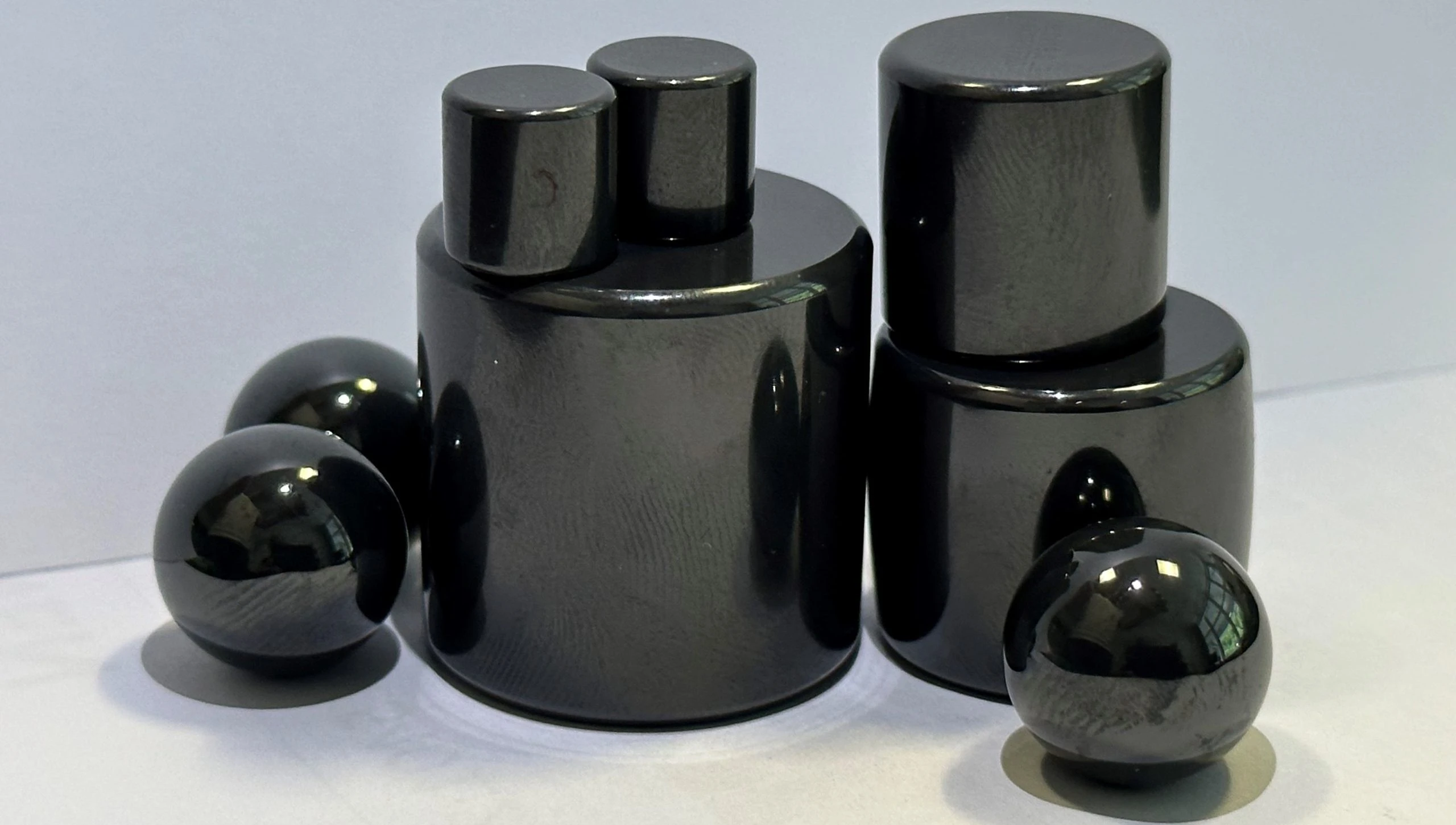
Hybrid bearings combine bearing rings made of standard rolling bearing steel (e.g. 100Cr6, AISI440C) with rolling elements made of silicon nitride (Si₃N₄).
All dimensions and tolerances remain unchanged. HYTEC hybrid bearings can therefore replace standard rolling bearings without any modification to adjacent structures.
Si₃N₄ rolling elements offer a range of advantages in many applications, particularly under critical and demanding environmental conditions.
The bearing-grade silicon nitride used in HYTEC rolling elements features a uniform and extremely fine microstructure with high purity. It combines very high strength and toughness, chemical inertness, and excellent electrical insulation properties.
Material Characteristics (Werkstoffeigenschaften)
| Parameter | Unit | Si₃N₄ | 100Cr6 |
|---|---|---|---|
| Density | [g/cm³] | 3.23 | 7.8 |
| Hardness HV10 up to temp. | [kg/mm²] | 1600 - 800°C | 720 - 150°C |
| Compression strength | [MPa] | 4000 | ~2300 |
| Tensile strength | [MPa] | 800 | ~1900 |
| Modulus of elasticity | [kN/mm²] | 310 | 210 |
| Coefficient of linear expansion | [10⁻⁶/K] | 3 | 11.7 |
| Electrical resistance | Ωm | 10¹² — Insulator | 0.4×10⁻⁶ — Conductor |
Advantages of HYTEC Hybrid Bearings
Excellent Electrical Insulation
Silicon nitride is an excellent insulator and can serve as rolling elements to replace ceramic-coated inner or outer rings.
For smaller and medium-sized bearings, hybrid bearings are generally a more economical solution.
The dielectric strength of Si₃N₄ balls is 15,000 V/mm, whereas coating thickness on bearing rings is limited to a maximum of 0.5 mm.
Low Friction
Silicon nitride has lower friction against steel. At the same rotational speed, hybrid rolling bearings operate at lower temperatures.
This results in extended service life for both the bearing and the lubricant.
Combined with synthetic high-performance greases (e.g. ester oil/polyurea base such as DUROLUB G237), bearing service life can be extended several times over.
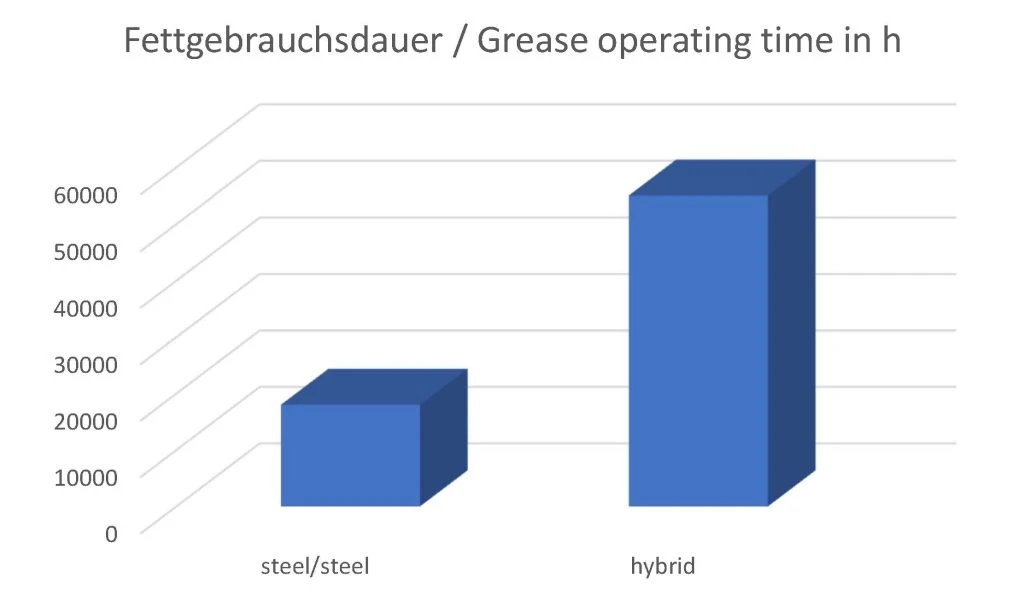
Grease Service Life (Fettgebrauchsdauer) — Ball bearing d=60mm / 3000min⁻¹
Higher Speed / Acceleration / Rigidity
Si₃N₄ balls have a density 59% lower than steel balls, thereby reducing centrifugal forces and inertia forces during bearing acceleration and deceleration.
Due to lower friction and lower operating temperatures, hybrid bearings can run at higher speeds.
Typically, the speed limit of deep groove ball bearings is increased by 20%, and high-performance spindle bearings can achieve ndmmax values of up to 3 million.
Due to an elastic modulus that is 50% higher, hybrid bearings offer greater rigidity.
Resistance to Temperature Fluctuations and High Operating Temperatures
Due to a 76% lower coefficient of thermal expansion, HYTEC hybrid bearings are significantly less sensitive to temperature fluctuations in operation.
Operating bearing clearance can be set more precisely. Silicon nitride retains almost the same hardness at 800°C.
In combination with heat-resistant bearing rings and suitable dry lubrication, hybrid rolling bearings can be used at operating temperatures up to 400°C.
Extended Bearing and Lubrication Service Life in Critical Applications
Friction between steel and silicon nitride is very low, resulting in lower operating temperatures and reduced wear.
This leads to longer service life. The lubricant film thickness required for hybrid bearings is significantly lower, enabling operation even under insufficient lubrication or mixed/boundary friction conditions.
Even under dry-running conditions without lubrication, hybrid bearings are less prone to seizure and can operate for longer periods in a completely unlubricated emergency run.
High Resistance to Contamination Particles Inside the Bearing
Si₃N₄ rolling elements are generally harder than typical contamination particles found inside bearings. The rolling elements crush or press particles into the raceway as they roll over them, and subsequent rolling elements flatten them further.
High Resistance to Vibration
HYTEC hybrid bearings are relatively insensitive to standstill vibration. Damage such as false brinelling can therefore be largely avoided.
Manufacturing of HYTEC Hybrid Bearings
Bearing rings and cages are sourced from well-known European and Japanese manufacturers.
Our bearing-grade Si₃N₄ balls, with optimum microstructure and porosity, are assembled into these bearing rings in Austria.
Our high-performance lubricants come from well-known German manufacturers; we are also happy to use lubricants specified by the customer.
For the food industry, NSF H1-certified lubricants are used, typically in combination with bearings made from corrosion-resistant materials.
The minimum order quantity is 1 piece. Our customers can therefore test hybrid bearings in the smallest quantities.
Small batch production can usually be completed within 2–4 days.
For volume production solutions, manufacturing partners are available in both Europe and Asia. From medium batch sizes onward, a wide range of high-performance material combinations such as PEEK, FKM, and high-performance steels are available.
Which Bearing Types Can Be Manufactured as Hybrid Bearings
The procurement cost of hybrid bearings is always significantly higher than that of all-steel bearings. Ball bearings up to medium sizes can currently be manufactured "economically."
As the ball size used increases, manufacturing costs rise substantially.
Ceramic rollers are extremely expensive and are only installed upon customer request. Lead times for standard rollers are 3–5 weeks.
Marking / Packaging / Labeling
Bearings are not retroactively marked. The marking on the bearing is therefore original and unchanged.
Packaged in original manufacturer packaging with an additional identification label.
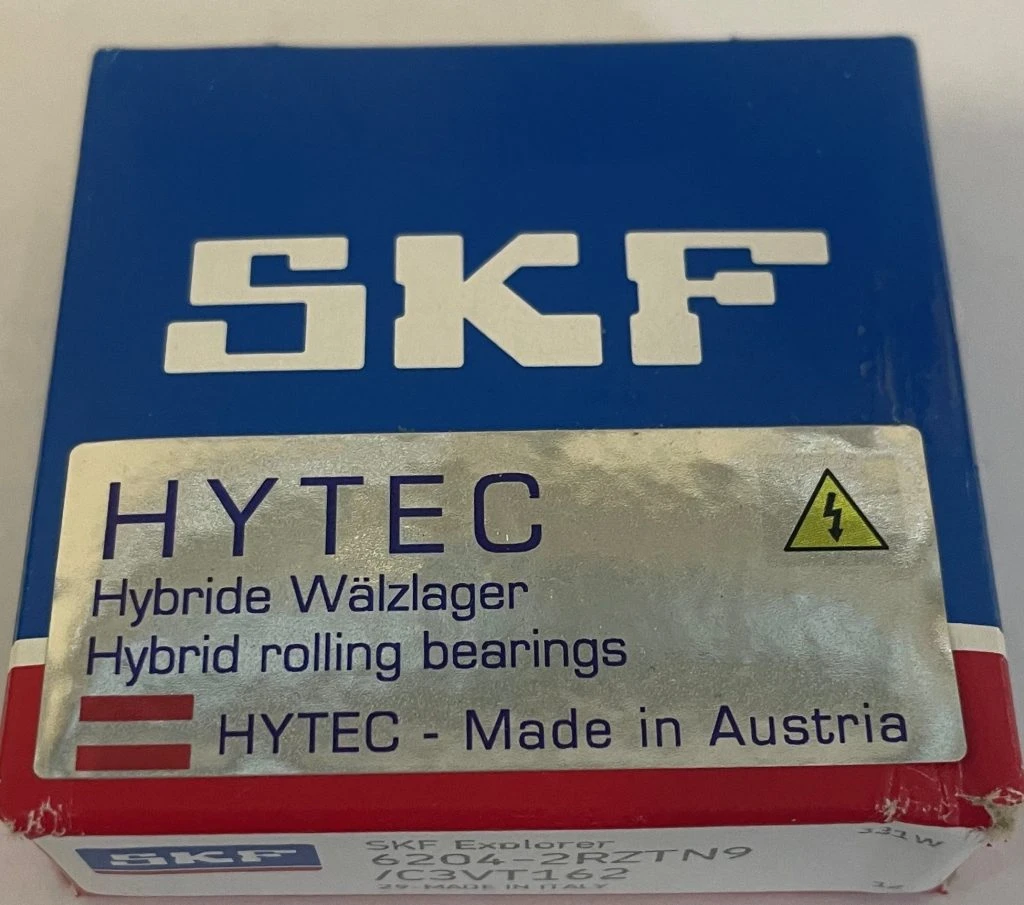
HYTEC Hybrid Bearing
HYTEC Product Specification Label