Correct design is the foundation for ensuring long-term, reliable bearing operation. The content of this page is based on the official myonic technical catalogue (page 27) and details the geometric parameters and structural requirements that must be strictly observed during the design phase.
Design errors may lead to:
- Premature bearing failure
- Raceway damage (Brinelling)
- Seal failure
- Inability to install or remove the bearing correctly
1. Key Design Parameter Definitions
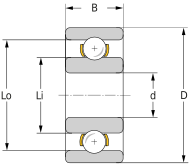
To ensure correct installation and operation of the bearing, the design of the shaft and the housing seat must strictly adhere to the following dimensional parameters (see the product tables):
| Symbol | Definition | Key Design Requirement |
|---|---|---|
| d | Bearing inner diameter | Nominal bore diameter of the bearing inner ring |
| D | Bearing outside diameter | Nominal outside diameter of the bearing outer ring |
| B (Bf) | Bearing width | Nominal overall width of the bearing rings |
| Li | Minimum permissible shoulder diameter of the housing seat | Must be ≥ this value to ensure the outer ring is adequately supported without contacting the inner ring. |
| Lo | Maximum permissible shoulder diameter of the shaft | Must be ≤ this value to ensure the inner ring is adequately supported without contacting the outer ring. |
| r max | Maximum permissible rounding radius | The corner radius of the shaft or housing seat must be ≤ this value so the bearing seats fully against the shoulder. |
| h min | Minimum permissible shoulder height | The shoulder height of the shaft or housing seat must be ≥ this value to provide reliable axial location. |
2. Please Avoid the Following Designs
Refer to the official illustrations, Figures 1 – 4. The following are common design errors:
Figure 1 Rounding radius too large
Error: The rounding radius r of the shaft or housing seat is larger than the bearing's r max.
Consequence: The bearing cannot seat against the shoulder, so its axial position is not stable; forcing it into place deforms the bearing ring.
Figure 2 & 3 Insufficient shoulder height
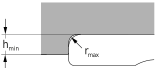
Error: The height of the shoulder or retaining ring is lower than h min.
Consequence: The support area is insufficient, and the bearing ring may deform under load or shift axially.
Figure 4 Shaft shoulder diameter too large
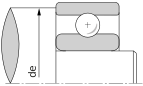
Error: The shaft shoulder diameter De is larger than the specified Lo.
Consequence: The shaft shoulder contacts the face of the stationary outer ring, causing rotational interference.
3. Please Ensure the Following Designs
A correct design must not only avoid the errors above but also account for the load path during installation and for ease of future maintenance (refer to the official illustrations, Figures 6 – 9).
Figure 6 Key rule: the load path
The mounting or dismounting force must act directly on the ring with the interference fit!
The mounting force must never be transmitted through the rolling elements (balls). Doing so causes tiny indentations on the raceway (Brinelling), which is the most common cause of bearing noise and premature failure.
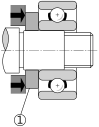
Design for Disassembly
Miniature bearings are usually a very tight fit, so the design must consider how the bearing will later be removed without damaging the surrounding components.
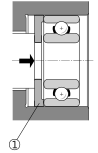
Figure 7 Use an intermediate ring

Place an intermediate ring (1) between the shaft/housing shoulder and the bearing. For removal, simply push against the intermediate ring to press the bearing out.
Figure 8 Machine an extraction groove

If there is no room for an intermediate ring, an extraction groove should be machined into the shoulder of the shaft or housing seat so the claws of a puller tool can engage.
Figure 9 The ideal design structure
This is a design example that combines all the correct parameters:
- Both Li and Lo are strictly observed, with no part causing interference.
- The rounding radius r < r max, so the bearing seats fully against the shoulder.
- The shoulder height h > h min, providing the bearing with adequate axial support.
- The design includes an extraction groove or uses an intermediate ring for ease of maintenance.
Damage Caused by Incorrect Handling (Common Cases)
Even when the design parameters are correct, improper handling and installation can permanently damage the bearing. The following are typical examples of such damage:

Raceway damage caused by foreign particles

Damage caused by insufficient lubrication

Raceway damage caused by overload
Technical Consultation
If you have any questions regarding design or installation, please contact the myonic technical support team.
Our engineers have extensive experience in miniature bearing applications and can provide professional technical guidance and customized solutions.