Design Principles
The following notes describe the design requirements for the adjacent construction of AXRY-NGX bearings. Particular attention must be paid to the precision of the mating surfaces, because deviations affect the overall accuracy of the rolling bearing and, in turn, the shaft system. To avoid any deterioration of the bearing friction torque, running accuracy and running characteristics, the recommended tolerances must not be exceeded.
Press fits
In principle, an excessively tight fit increases the radial preload of the bearing, and therefore:
Increases:
- Surface pressure in the raceway
- Bearing friction
- Bearing temperature rise
- Wear
Decreases:
- Maximum speed
- Service life
Clearance fit
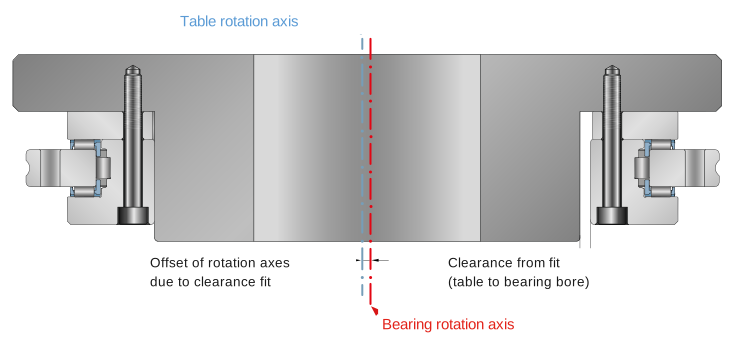
With a clearance fit, if the rotating bearing ring is not supported across the whole surface, the axis of rotation may be displaced (the bearing axis deviates from the table axis). The fit clearance (between the table and the bearing bore; likewise the clearance between the outer diameter and the table when the outer ring rotates) may add to the radial runout.
Deliberately using a clearance fit to compensate for the thermal expansion of the individual bearing rings can make sense in certain cases, but it requires precise knowledge and control of the temperature of each ring. Under all operating conditions of the machine tool, the risk of runout errors and displacement of the centre of rotation must be carefully assessed.
A lack of, or insufficient, support of the inner ring leads to undefined operating conditions such as vibrations, runout errors and repeatability problems.
Recommended minimum wall thickness of the table
- Bearing size: Bearing size designation
- Min. wall thickness [mm]: Recommended minimum wall thickness of the table (mm)
- Max. passage [mm]: Maximum passage (through-bore) diameter (mm)
| Bearing size | Min. wall thickness [mm] | Max. passage [mm] |
|---|---|---|
| AXRY 180-NGX (NGX-SBI) | 19 | 142 |
| AXRY 200-NGX (NGX-SBI) | 22 | 156 |
| AXRY 260-NGX (NGX-SBI) | 26 | 209 |
| AXRY 325-NGX (NGX-SBI) | 27 | 271 |
| AXRY 395-NGX (NGX-SBI) | 27 | 340 |
| AXRY 460-NGX (NGX-SBI) | 30 | 400 |
| AXRY 580-NGX (NGX-SBI) | 36 | 508 |
| AXRY 650-NGX (NGX-SBI) | 45 | 560 |