Areas of Application
AXRY-NGS (NGS-SBI) bearings are suitable for applications requiring high load-capacity, ultra-precise and play-free high-speed bearings. Typical applications include:
- Rotary tables of mill/turn machining centers
- Vertical lathes
- Gear cutting machine tools
To fully exploit the advantages of the NGS series, the design of the adjacent construction is also important. The entire system of the axis must be considered, including lubrication, cooling, heat flow, and the components themselves, in order to achieve optimal results.
Accuracy Requirements
For higher accuracy requirements, the NGS and NGS-SBI series are available with tighter axial and radial runout accuracies.
The inner ring and the axial washer have identical axial runout characteristics.
| Model | Standard | High Precision (PRR50) | Ultra-High Precision (PRR30) | |||
|---|---|---|---|---|---|---|
| PL [μm] | RL [μm] | PL [μm] | RL [μm] | PL [μm] | RL [μm] | |
| AXRY 120-NGS (NGS-SBI) | 3 | 3 | 1.5 | 1.5 | - | - |
| AXRY 200-NGS (NGS-SBI) | 4 | 4 | 2 | 2 | - | - |
| AXRY 260-NGS (NGS-SBI) | 6 | 6 | 3 | 3 | 2 | 2 |
| AXRY 325-NGS (NGS-SBI) | 6 | 6 | 3 | 3 | 2 | 2 |
| AXRY 395-NGS (NGS-SBI) | 6 | 6 | 3 | 3 | 2 | 2 |
| AXRY 460-NGS (NGS-SBI) | 6 | 6 | 3 | 3 | 2 | 2 |
| AXRY 580-NGS (NGS-SBI) | 10 | 10 | 5 | 5 | 3 | 3 |
| AXRY 650-NGS (NGS-SBI) | 10 | 10 | 5 | 5 | 3 | 3 |
PL = Axial runout, RL = Radial runout
Measuring Systems
AXRY-NGS bearings can be equipped with inductive angle measurement systems. These systems are available in incremental or absolute versions, as single-head or multi-head systems, with different accuracy grades.
myonic supplies only the "mechanical part" — the bearing, including the mounted measuring ring and the threads on the outer ring for mounting axial or radial scanning heads. For high-speed applications, only absolute measurement systems are suitable. Incremental measurement systems are not suitable for high speeds.
By mounting the measuring ring directly on the bearing ring, concentricity errors with respect to the shaft (table) are minimised, thereby achieving the highest accuracies of a few angular seconds.
Lubrication Methods
Grease Lubrication, Relubrication
For high-speed bearings, relubrication at appropriate intervals should be scheduled.
A good option is a controlled relubrication system that relubricates with small quantities of lubricant at defined intervals during operation.
For the calculation of relubrication quantities and intervals, please write to sales@eb-system.com, stating the load spectrum (speed, duty cycle, load) and the environmental conditions.
Circulating Oil Lubrication
Primarily used for larger bearings. Due to the larger volume of cooling oil, cooling and lubrication take place simultaneously.
Because of the large amount of available lubricant, these systems can also use oils of lower viscosity.
Oil/Air Lubrication
Similar to spindle bearings, the oil/air mixture is injected directly into or next to the raceways; lubrication takes place with minimal oil quantities. Lubrication is supplied axially through 6 holes in the outer ring.
myonic bearings can be supplied with all necessary holes, connection threads, and seals for oil/air lubrication.
The customer must define parameters such as the lubrication cycle, lubricant quantity, and air pressure according to the application. Our engineering team can provide support.
Overlubrication
Overlubrication, whether with grease or oil, leads directly to an increase of the friction in the bearings and to strong increases in temperature. This can cause premature bearing failure.
If the bearing has been over-lubricated, repeat the run-in cycle to restore the original friction torque.
Lubrication Holes / Lubrication Grooves
Inner Ring Rotation
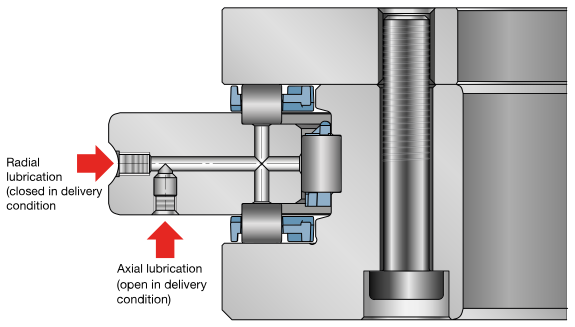
NGS bearings for inner ring rotation can be lubricated through a radial circumferential groove on the outer ring or axially. To correctly align the bearing lubrication holes with the lubrication holes in the machine housing, the bearing has locating pin holes. (See the Positioning Holes chapter)
For relubrication through the outer ring / inner ring lubrication groove, we recommend completely filling the lubrication groove with grease before assembling the bearing. This allows the grease to reach the bearing faster during relubrication. The lubrication channel in the housing should be positioned close to the radial lubrication hole of the bearing.
Please ensure that the axial lubrication holes are closed with set screws on delivery. For axial lubrication, remove the axial set screws and close the radial side.
Outer Ring Rotation
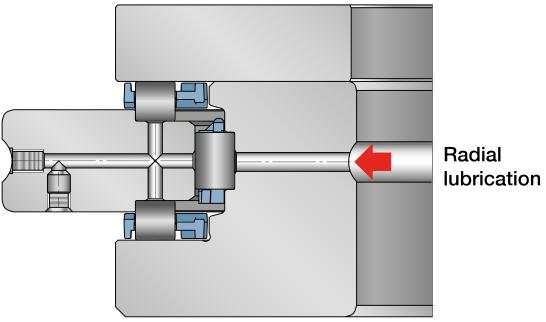
NGS-SBI bearings for outer ring rotation can be lubricated through a radial circumferential groove on the inner ring.
When relubricating through the lubrication groove, it is recommended to completely fill the groove with grease. The lubrication hole in the bearing should be positioned close to the lubrication channel in the housing.
Inner Ring Rotation (Oil-Air Lubrication)
NGS bearings for inner ring rotation are available as a special design for oil-air lubrication. This series has 6 evenly arranged lubrication holes in the outer ring.
Lubricant can enter axially from both sides. As the lubricant enters the bearing, it is directed 3 times toward the inner ring and 3 times toward the axial washer.
The exit side in the bearing is indicated by arrow markings on the outer ring.
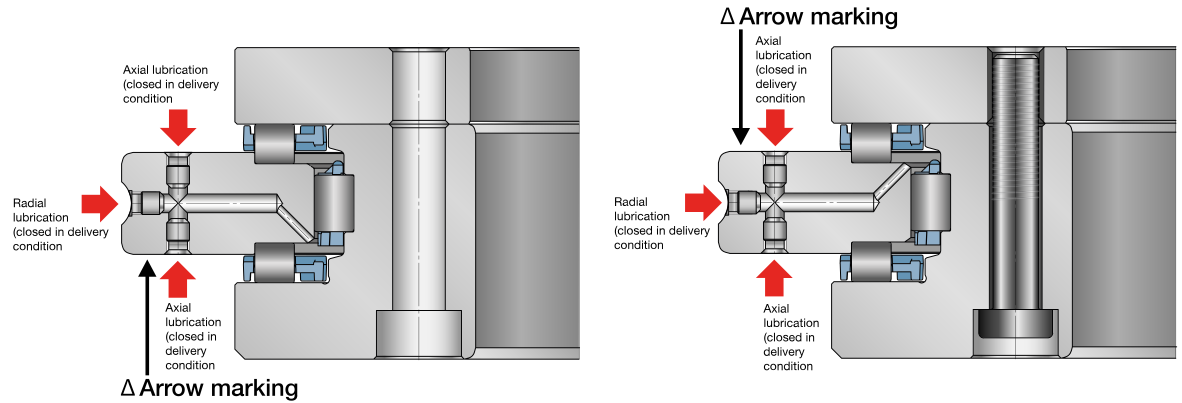
On delivery, all lubrication holes are closed with set screws. For lubrication, remove the relevant set screws.
For all bearing sizes, the lubrication holes are uniformly designed with M4 threads.
Sealing
When using oil-air lubrication, it is recommended to equip the bearing with a non-contact gap seal. This keeps the oil-air lubrication within the bearing working space, ensuring optimal lubrication. Due to the extremely small gap between the seal and the outer ring, the oil-air lubrication also acts as sealing air. This effectively protects the bearing from contamination.
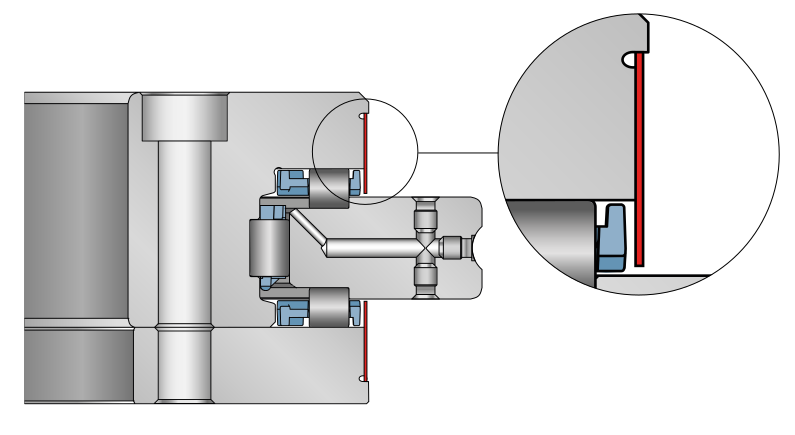
Sensor Bore / Bearing Monitoring
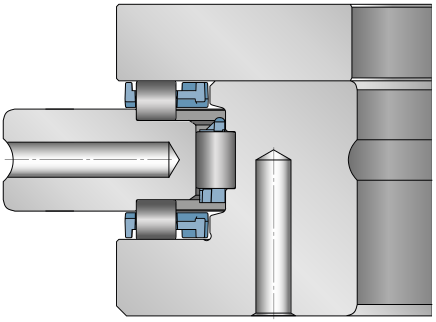
AXRY-NGS bearings have a sensor bore in the outer ring as standard, and NGS-SBI bearings also have a sensor bore in the inner ring. These sensor bores extend beneath the raceway.
When equipped with a temperature sensor, the current temperature in the bearing system can be used to continuously monitor and control the cooling, or to detect overheating of the system.
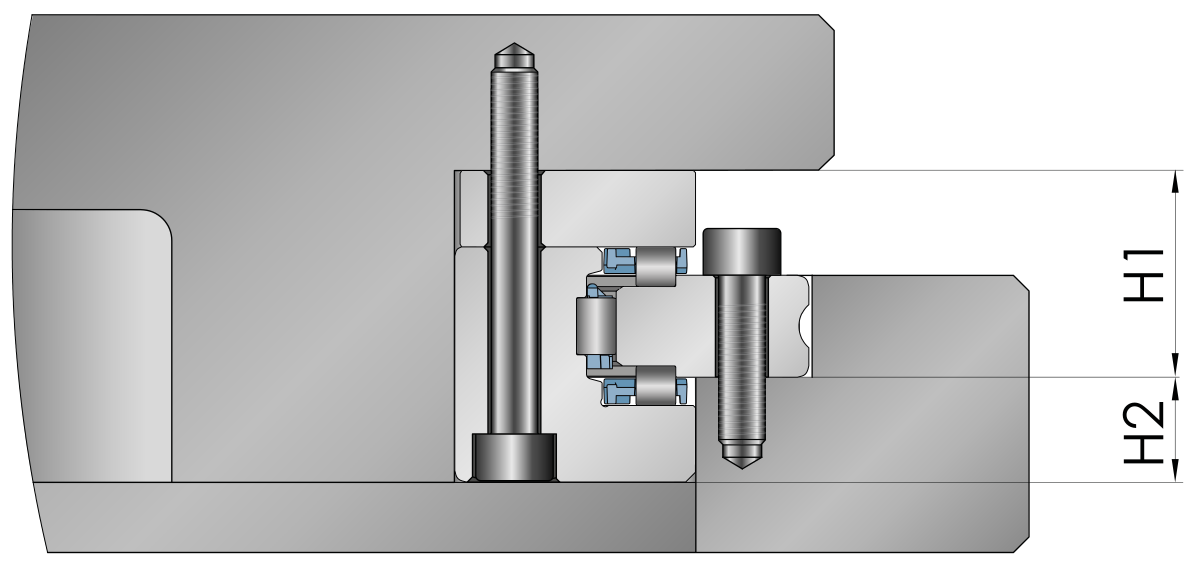
Height Tolerances H1 and H2
Both height dimensions H1 and H2 can be significantly restricted.
Height dimension H1 is restricted as standard up to and including size 460. Sizes 580 and 650 can optionally be restricted.
H1 refers to the position of the worktable. The restricted height variation provides the following advantages:
- The labyrinth seal gap can be optimally adjusted to prevent coolant from penetrating from the machining area
- The clamping gap can be optimally adjusted
Height dimension H2 is not restricted as standard, but all sizes can be supplied in a restricted version.
H2 refers to the adjacent construction below the bearing, for example for adjusting the worm gear clearance.
The exact tolerances are given in the product tables.
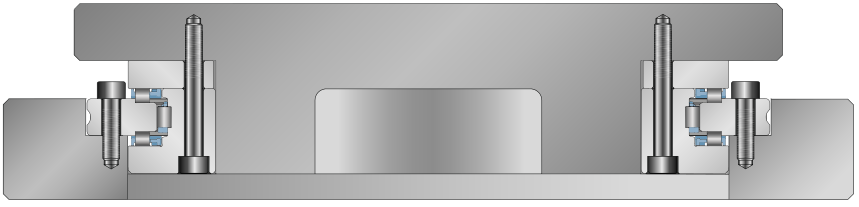
Customer-Specific Bearing Adjustment AC
AXRY-NGS (NGS-SBI) bearings can be mounted as exposed bearings or with whole-surface support. If the L-section ring is fully supported by a support ring, the tilting rigidity of the bearing increases by 15 to 20%.
To prevent the bearing friction torque from increasing, the bearing alignment can be adjusted (suffix AC). If a normally aligned bearing is used with a supported L-section ring, the bearing friction torque increases significantly.
The height of the support ring should be at least twice that of the axial washer.
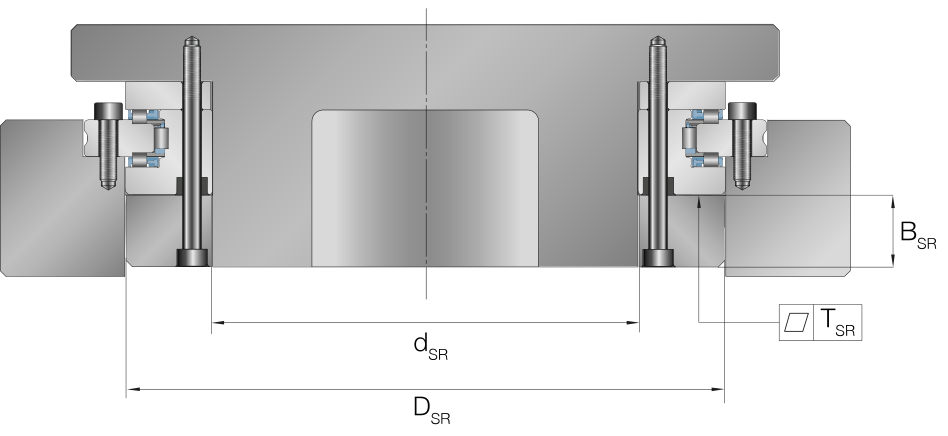
Support Ring Dimensions
| Bearing Size | Inner Diameter dSR [mm] | Outer Diameter DSR [mm] | Width BSR [mm] | Flatness TSR [μm] |
|---|---|---|---|---|
| AXRY 120-NGS (-SBI) | 121.5 | 184 | 18 | 4 |
| AXRY 200-NGS (-SBI) | 201.5 | 274 | 20 | 5 |
| AXRY 260-NGS (-SBI) | 261.5 | 345 | 27 | 7 |
| AXRY 325-NGS (-SBI) | 326.5 | 415 | 30 | 7 |
| AXRY 395-NGS (-SBI) | 396.5 | 486 | 35 | 7 |
| AXRY 460-NGS (-SBI) | 461.5 | 560 | 38 | 7 |
| AXRY 580-NGS (-SBI) | 581.5 | 700 | 42 | 8 |
| AXRY 650-NGS (-SBI) | 651.5 | 800 | 64 | 10 |
Customer-Specific Design Jxxxx
myonic offers customer-specific designs which are designated with a J and a four-digit number.
Bearings with a J designation can include the following additional features:
- Application-specific preload values
- Special instructions for marking or packaging
- Customer-specific special measurements
Limiting Speed nG
The limiting speeds given in the product tables are guide values determined on our test benches under the following conditions:
- Grease distribution run-in according to the specified procedure (see run-in cycle)
- Maximum bearing temperature rise of 40K in the raceway area (sensor bore)
- Active bearing cooling
- 2-hour duty cycle operation at the limiting speed nG
- Bearing fully bolted, no external loads, only preload and the weight of the mounting parts
To achieve these limiting speeds, the guidelines for the adjacent construction must be strictly observed. Please also note the Friction / Temperature Development section.
Friction / Temperature Development
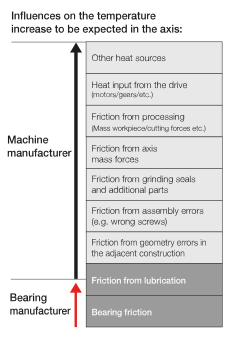
The axial-radial bearings of the AXRY-NGS (NGS-SBI) series feature cages in both the radial and axial sections. This ensures that the bearings rotate with very low friction at full preload. At higher speeds, the friction torque increases only slightly, so bearings of the AXRY-NGS (NGS-SBI) series can run at high speeds over long duty cycles.
During prolonged high-speed operation, the factors that increase bearing friction and temperature must be avoided or compensated. For this, the entire axis, including all drives, must be considered.
Main factors influencing the axis friction torque:
- Bearing friction torque: After assembly and complete bolting, the bearing is radially and axially play-free and preloaded. Preload is one factor in achieving the specified rigidity, but it also generates friction torque.
- Lubricant used: In high-speed applications, the bearing lubricant must be carefully selected. Only a few greases with a suitable viscosity are appropriate for higher speeds. The viscosity depends on the selected lubricant and the operating temperature. Low-viscosity lubricants can cause mixed friction, especially during slow or intermittent operation under high loads. On the other hand, an excessively high viscosity causes high friction and is barely suitable for fast-rotating applications.
The following points must be observed when designing the axis and during assembly:
- Geometric errors in the adjacent construction lead to deformation of the bearing and thus to a higher friction torque. Please observe our recommendations in the Adjacent Construction Design section.
- Asymmetric housings can deform when heated, thereby increasing the bearing preload.
- Assembly errors can increase the friction torque. We recommend rotating the bearing and measuring the friction torque during assembly. This can reveal serious errors regarding the adjacent construction geometry, screw connections, or additional parts.
- Contact seals increase the friction torque and introduce additional heat into the system. For high-speed axes, contact seals should be avoided wherever possible.
- High accelerations and strong braking processes can introduce additional friction into the system through moments of inertia.
- Machining forces, eccentric clamping, and high loads increase the friction torque.
- Heat input from the drives should be reduced to a minimum.
Only by considering the entire system can a sufficient level of knowledge be obtained for the design of a suitable cooling or heating/cooling system.
Our test bench results show the basic performance capability of the bearings and lubricants, but only limited conclusions can be drawn about the actual operating temperature of a machine tool axis.