Areas of Application
AXRY-NGX (NGX-SBI) bearings are suitable for applications requiring high load capacity, ultra-precise and play-free high-rigidity bearings. Typical applications include:
- Rotary tables of milling machining centers
- Milling heads
- Swivel axes
To fully exploit the advantages of the NGX series, the design of the adjacent construction is also important. The overall shaft system must be considered — such as the precision of fits and connecting parts — in order to achieve the best results.
Accuracy Requirements
For higher accuracy requirements, the NGX and NGX-SBI series are available with more tightly restricted axial and radial runout accuracy.
The inner ring and the axial washer have identical axial runout characteristics.
- PL: Axial runout (Axialplanlauf) [μm]
- RL: Radial runout (Radialrundlauf) [μm]
- –: This accuracy grade is not available for this size
Axial and Radial Runout Accuracy Table
| Model | Standard PL & RL [µm] | Restricted PL & RL [µm] | Highly Restricted PL & RL [µm] |
|---|---|---|---|
| AXRY 180-NGX (NGX-SBI) | 4 | 2 | - |
| AXRY 200-NGX (NGX-SBI) | 4 | 2 | - |
| AXRY 260-NGX (NGX-SBI) | 6 | 3 | 2 |
| AXRY 325-NGX (NGX-SBI) | 6 | 3 | 2 |
| AXRY 395-NGX (NGX-SBI) | 6 | 3 | 2 |
| AXRY 460-NGX (NGX-SBI) | 6 | 3 | 2 |
| AXRY 580-NGX (NGX-SBI) | 10 | 5 | 3 |
| AXRY 650-NGX (NGX-SBI) | 10 | 5 | 3 |
Measuring Systems
AXRY-NGX bearings can be equipped with inductive angle measurement systems. These systems are available in incremental or absolute versions, offered as single-head or multi-head systems in various accuracy grades.
myonic supplies only the "mechanical part", i.e. the bearing including the installed measuring ring and the threaded outer ring for mounting an axial or radial scanning head.
By mounting the measuring ring directly on the bearing ring, the concentricity error relative to the shaft (table) is minimized, achieving the highest accuracies of a few angular seconds.
More information: Axial/Radial Bearing Angle Measurement Systems →
Run-in Cycle - Lubrication / L120 / Gxxx
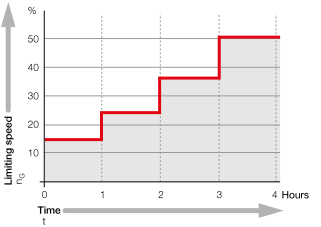
Fig: Run-in cycle diagram
For grease lubrication, a run-in cycle should be performed during commissioning in order to distribute the grease within the bearing. Only after complete distribution can the bearing reach full functionality.
Warning
An incorrectly performed run-in cycle can result in high friction torque, causing the bearing to overheat.
For slowly running swivel axes, no run-in cycle is required.
Lubrication Methods
Grease Lubrication
The standard grease is a special grease per DIN 51825-KPH-C1N-30.
AXRY-NGX bearings are relubricated via the outer ring, NGX-SBI via the inner ring. We generally recommend relubrication once a year. A run-in cycle is recommended after relubrication.
More information on grease lubrication: Technical Basics - Lubrication →
For relubrication quantities, please email sales@eb-system.com.
Oil Lubrication
Of course, AXRY-NGX (NGX-SBI) bearings can also be oil lubricated. These bearings are typically connected to a central oil lubrication system. Use the suffix -L120 to obtain grease-free bearings (corrosion protection only).
Over-lubrication Warning
Whether grease or oil is used, over-lubrication leads directly to increased bearing friction and a significant rise in temperature, which can cause premature bearing failure.
If the bearing has been over-lubricated, repeat the run-in cycle to restore the original friction torque.
Lubrication Bores / Lubrication Grooves
Inner Ring Rotation (NGX)
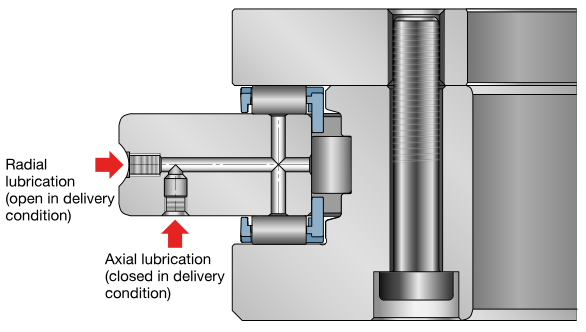
Fig: NGX inner ring rotation lubrication configuration
NGX bearings for inner ring rotation can be lubricated via the radial annular groove on the outer ring or axially. To correctly position the bearing lubrication bore relative to the lubrication bore in the machine housing, the bearing is provided with a locating pin hole. (See the Positioning Holes section.)
For relubrication via the outer-ring/inner-ring lubrication groove, it is recommended to completely fill the lubrication groove with grease before installing the bearing. This allows the grease to enter the bearing more quickly during relubrication. The lubrication channel of the housing should be close to the radial lubrication bore of the bearing.
Note
On delivery, the axial lubrication bore is closed with a plug. For axial lubrication, remove the plug axially and close the radial side.
Outer Ring Rotation (NGX-SBI)
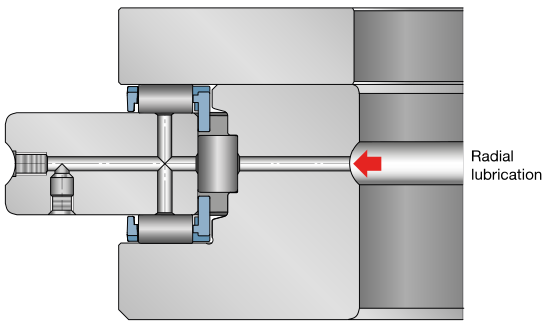
Fig: NGX-SBI outer ring rotation lubrication configuration
NGX-SBI bearings for outer ring rotation can be lubricated via the radial annular groove on the inner ring.
For relubrication via the lubrication groove, it is recommended to completely fill the lubrication groove with grease. The bearing lubrication bore should be close to the lubrication channel of the housing.
Height Tolerances H1 and H2
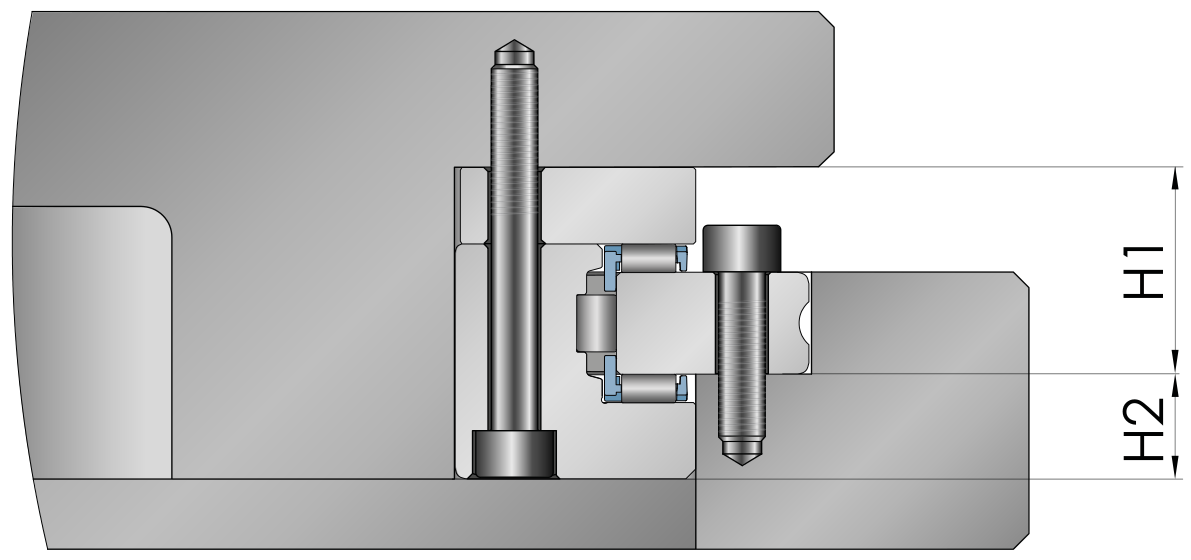
Fig: Height tolerances H1 and H2 diagram
The height dimensions H1 and H2 come with restricted tolerances as standard up to bearing size 460. For sizes 580 and 650, restricted tolerances are available as an option.
H1 - Table Position
Restricted height variation offers the following advantages:
- The labyrinth seal gap can be optimally adjusted against the ingress of coolant from the machining area
- The clamping gap can be optimally adjusted
H2 - Adjacent Construction Below the Bearing
H2 refers to the adjacent construction below the bearing, for example for adjusting the worm gear clearance.
For exact tolerances, please refer to the product tables.
Custom Bearing Adjustment AC
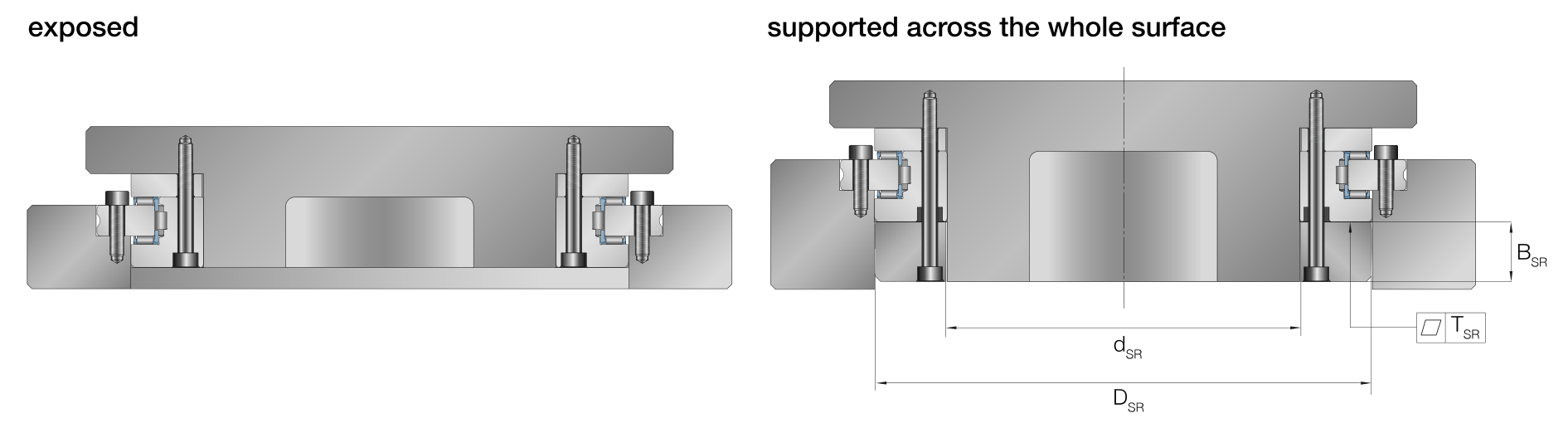
Fig: Support ring configuration diagram
AXRY-NGX (NGX-SBI) bearings can be installed as exposed bearings or with full-surface support. If the L-ring is supported over its full surface by a support ring, the tilting rigidity of the bearing can increase by approximately 15-20% (when using a standard bearing without the -AC suffix).
To prevent an increase in bearing friction torque, the bearing alignment can be adjusted (suffix -AC). If a normally aligned bearing is used with a supported L-ring, the bearing friction torque increases significantly.
The support ring height should be at least twice the height of the axial washer.
Recommended Support Ring Geometry for Maximum Rigidity
| Bearing Size Support Ring | ID dSR [mm] | OD DSR [mm] | Width BSR [mm] | Flatness TSR [µm] |
|---|---|---|---|---|
| AXRY 180-NGX (NGX-SBI) | 181.5 | 244 | 18 | 5 |
| AXRY 200-NGX (NGX-SBI) | 201.5 | 274 | 20 | 5 |
| AXRY 260-NGX (NGX-SBI) | 261.5 | 345 | 27 | 7 |
| AXRY 325-NGX (NGX-SBI) | 326.5 | 415 | 30 | 7 |
| AXRY 395-NGX (NGX-SBI) | 396.5 | 486 | 35 | 7 |
| AXRY 460-NGX (NGX-SBI) | 461.5 | 560 | 38 | 7 |
| AXRY 580-NGX (NGX-SBI) | 581.5 | 700 | 42 | 8 |
| AXRY 650-NGX (NGX-SBI) | 651.5 | 800 | 64 | 10 |
Custom Design Jxxxx
myonic offers custom designs indicated by a J followed by a four-digit number.
Bearings with a J number can include the following additional features:
- Application-specific preload values
- Special marking or packaging instructions
- Customer-specific special measurements
Limiting Speed nG
The limiting speeds given in the product tables can be achieved for the selected axial/radial bearing in oscillating operation or short-term continuous operation. During prolonged operation in the limiting speed range, the bearing temperature gradually rises. For high-speed applications such as milling/rotary tables, bearings of the AXRY-NGS design are recommended.
The limiting speeds are guide values determined on a test bench under the following conditions:
- Grease distribution run carried out as specified (see Run-in Cycle)
- Maximum bearing temperature rise of 40 K in the raceway area
- NGX without bearing cooling
- Bearing fully bolted, no external loads, only preload and the weight of the mounting parts
To reach these limiting speeds, the adjacent construction guidelines must be strictly observed.
Friction and Temperature
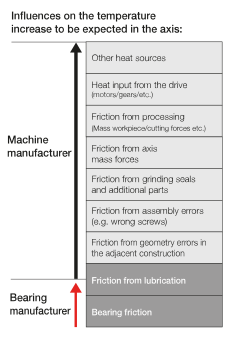
Fig: Friction and temperature relationship diagram
During prolonged high-speed operation, factors that lead to increased bearing friction and temperature must be avoided or compensated. For this, the entire shaft system, including all drives, must be taken into account.
The shaft friction torque is mainly influenced by the following factors:
- Bearing friction torque - After assembly and full bolting, the bearing is radially and axially play-free and preloaded. Preload is one factor in achieving the specified rigidity, but at the same time it generates friction torque.
- Lubricant used - In high-speed applications, the bearing lubricant must be carefully selected. The viscosity depends on the chosen lubricant and the operating temperature. A lubricant with too low a viscosity can lead to mixed friction; one with too high a viscosity causes high friction.
When designing the shaft and during assembly, the following points must be observed to minimize friction torque and temperature rise:
- Geometric errors in the adjacent construction cause bearing deformation, which results in higher friction torque
- An asymmetric housing deforms when heated, thereby increasing the bearing preload
- Assembly errors can cause an increase in friction torque
- Contact seals increase friction torque and transfer additional heat into the system
- High acceleration and hard braking can introduce additional friction into the system through moments of inertia
- Machining forces, eccentric clamping and high loads increase friction torque
- Heat input from the drives should be kept to a minimum