Preload and duplex installation technology can significantly improve bearing rigidity, running accuracy, and load capacity. By eliminating internal clearance, the bearings achieve higher positioning accuracy and lower vibration.
Why is Preload Necessary?
Increased Rigidity
Eliminates clearance and reduces axial and radial displacement
Running Accuracy
Reduces vibration and runout, improving rotational accuracy
Load Capacity
Distributes load evenly and extends bearing life
Reduced Noise & Vibration
Smooth operation with lower noise levels
Spring Preload
Spring preload uses a stainless steel spring washer to apply a constant axial preload force against the end face of the bearing ring. This method delivers a consistent and adjustable preload. myonic manufactures high-precision spring washers made of stainless steel for every standard bearing in the catalog.
Spring Preload vs Ground Preload
| Characteristic | Spring Preload | Ground Preload (Axial Offset) |
|---|---|---|
| Preload Force | Adjustable | Fixed |
| Temperature Adaptation | Excellent (self-compensating) | Moderate |
| Installation Complexity | Simple | Requires precision grinding |
| Cost | Moderate | Higher |
| Application | General precision applications | Ultra-high precision applications |
X Configuration (Suffix .9f)
The X configuration is the most common duplex installation. Its contact lines converge, allowing it to withstand both radial and axial loads simultaneously.
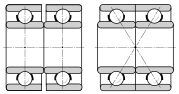
Illustration: X Configuration (face to face installation)
X Configuration Characteristics
- High Rigidity: Excellent performance under radial loads and axial loads in both directions
- Tilting Moment Resistance: Wide contact line distribution can withstand significant moment loads
- Versatile Application: Suitable for spindles, precision machine tools, medical equipment, and more
O Configuration (Suffix .9d)
The O configuration has diverging contact lines and provides very high resistance to tilting moments.
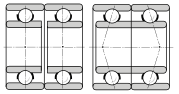
Illustration: O Configuration (back to back installation)
O Configuration Characteristics
Best Application Scenarios: The O configuration is particularly suitable for applications that must withstand large tilting moments, such as:
- Robot joints
- Rotary tables and indexing discs
- Rotation mechanisms of large telescopes
- Measuring equipment requiring high stability
Tandem Configuration (Suffix .9t)
The tandem configuration installs two bearings in the same direction, enabling it to withstand high axial loads in one direction.
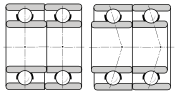
Illustration: Tandem Configuration
Tandem Configuration Characteristics
| Axial Load Capacity | Very High (unidirectional) |
| Radial Load Capacity | Moderate |
| Tilting Moment Resistance | Lower |
| Typical Applications | Ball screw drives, thrust applications |
Configuration Selection Guide
| Application Requirement | Recommended Configuration | Reason |
|---|---|---|
| High radial load + moderate axial load | X Configuration (.9f) | Balanced load distribution |
| High tilting moment | O Configuration (.9d) | Maximum moment rigidity |
| Unidirectional high axial load | Tandem (.9t) | Higher unidirectional axial load capacity |
| Spindle applications | X Configuration (.9f) | Best overall performance |
| Rotary table applications | O Configuration (.9d) | Strong anti-runout capability |