Other dimensions and characteristic curves available on request
Precision spring washers are essential accessories used for ball bearing preload and positioning. myonic offers a complete FS series of spring washers covering a wide range of sizes to meet different application requirements.
Precise Preload
Delivers a predictable axial spring force
Temperature Compensation
Automatically adjusts for thermal expansion variations
Vibration Reduction
Improves running smoothness
Measurement Notes
Measurement standard:
- The characteristic curves show the experimentally determined mean values for non-preset precision spring washers
- All data is subject to strict quality control to ensure consistency
Characteristic Curve Parameters
| Parameter | Symbol | Unit | Description |
|---|---|---|---|
| Axial load | F | N (Newton) | Compressive force applied to the washer |
| Total height | h+s | mm | Compressed height of the washer under load |
| Spring constant | k | N/mm | Ratio of load to deflection (slope of the curve) |
| Free height | h | mm | Original height of the washer with no load |
Characteristic Curve Charts
The following charts detail the load–deflection characteristics of each FS spring washer model. The horizontal axis is the total height (h+s) and the vertical axis is the axial load (F).
Chart 1 - FS Spring Washer Characteristic Curves (Group 1)
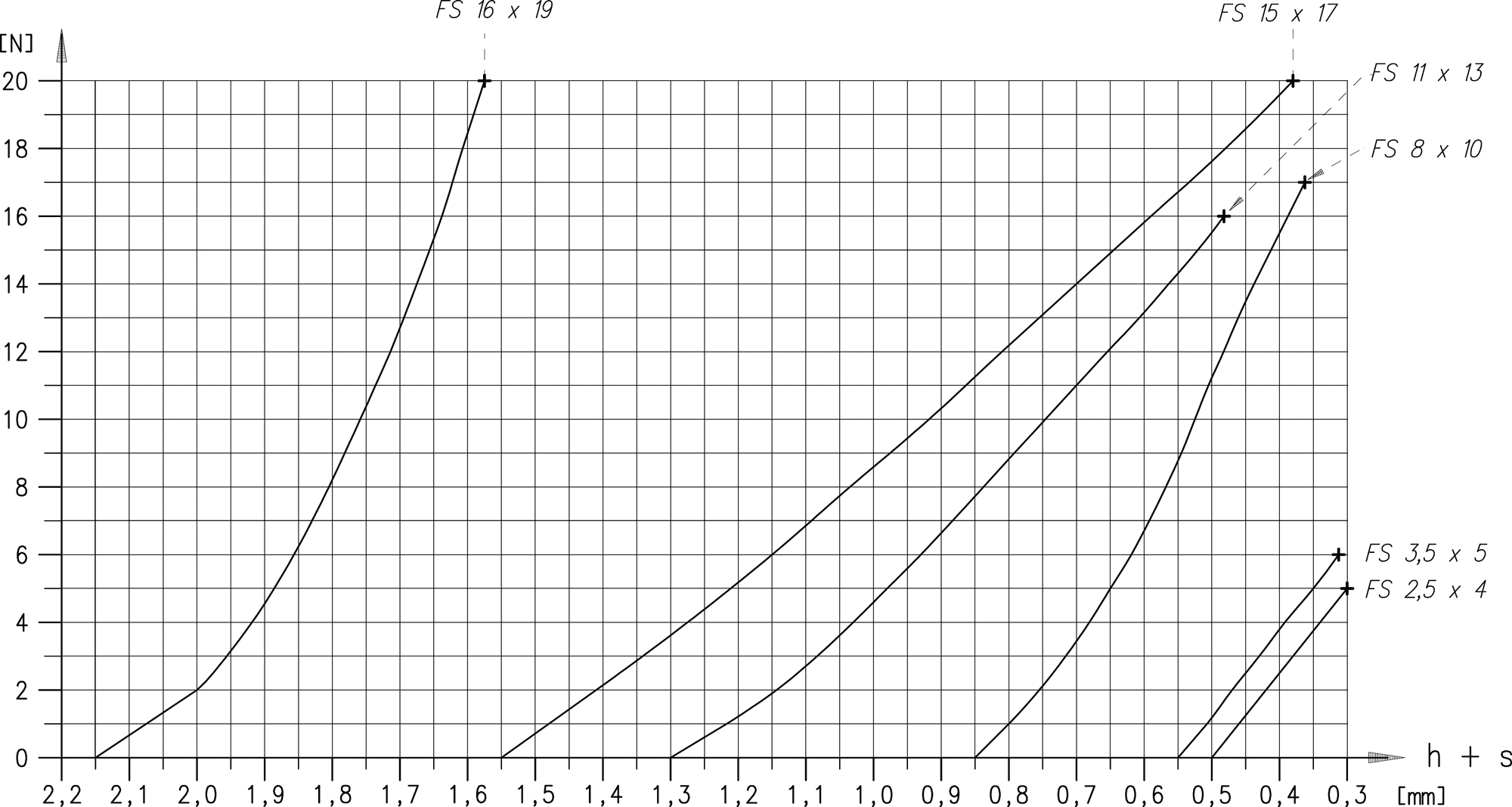
Models shown: FS 16×19, FS 15×17, FS 11×13, FS 8×10, FS 3.5×5, FS 2.5×4
Chart 2 - FS Spring Washer Characteristic Curves (Group 2)
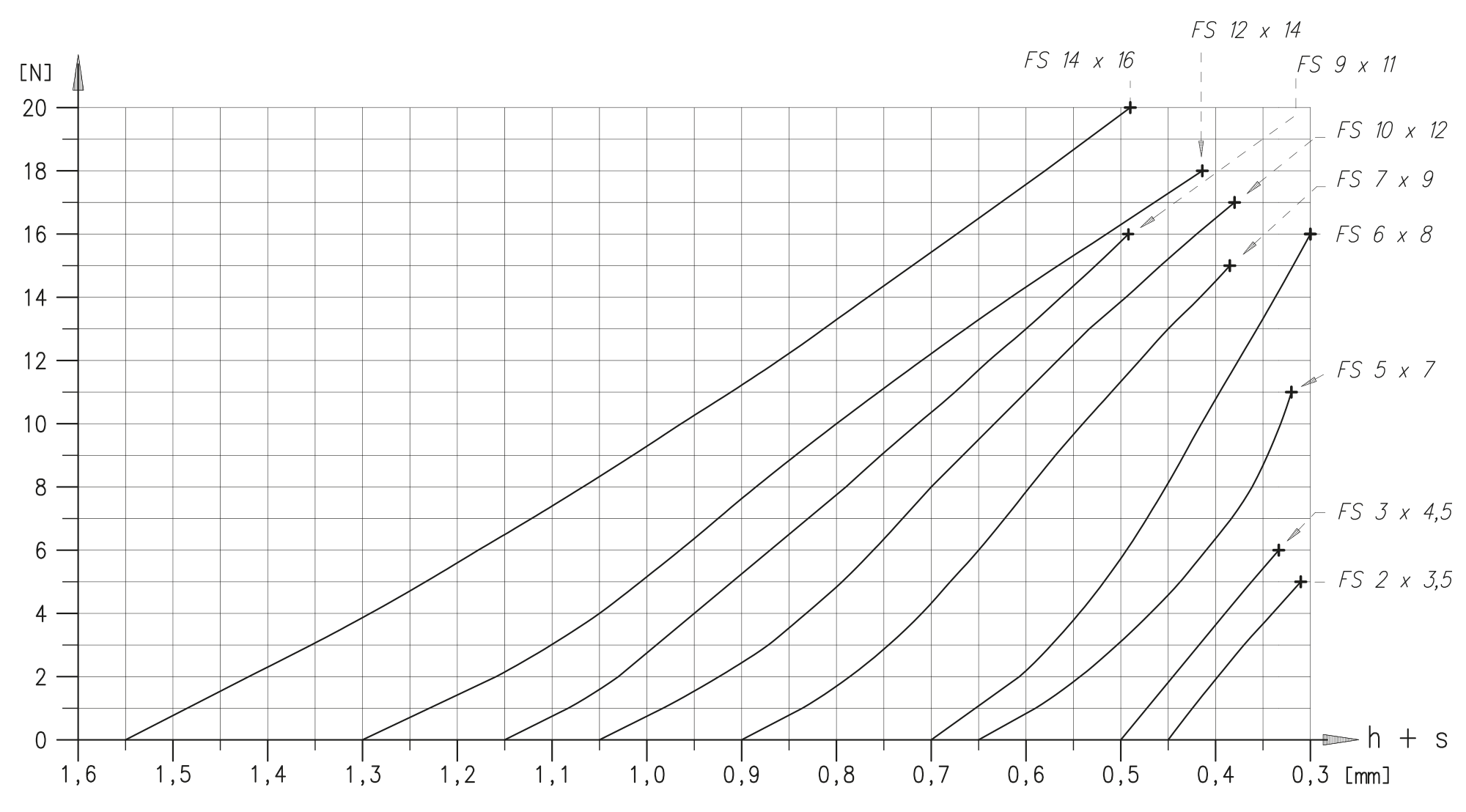
Models shown: FS 14×16, FS 12×14, FS 10×12, FS 9×11, FS 7×9, FS 6×8, FS 5×7, FS 3×4.5, FS 2×3.5
Chart 3 - FS Spring Washer Characteristic Curves (Group 3)
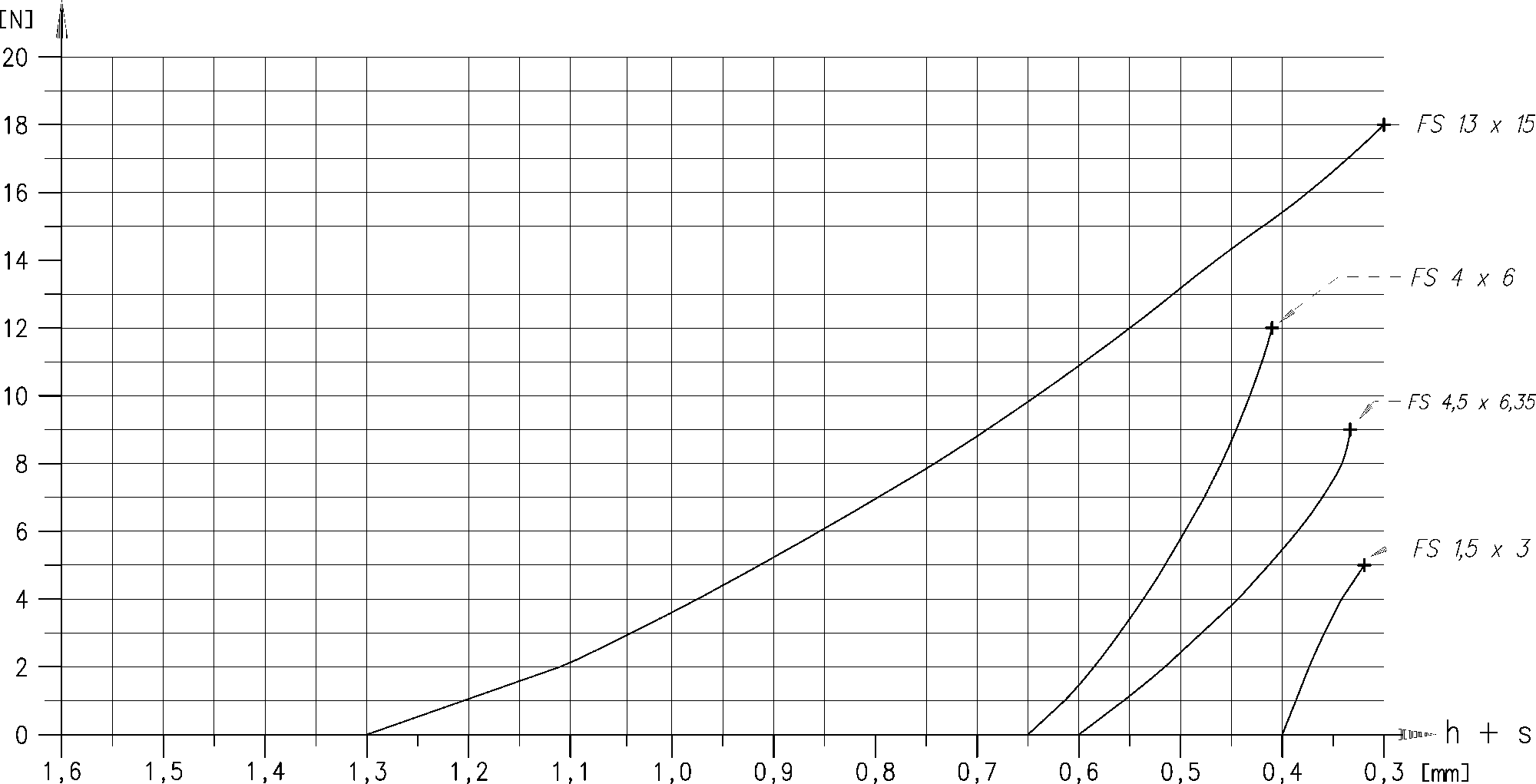
Models shown: FS 13×15, FS 4×6, FS 4.5×6.35, FS 1.5×3
How to read the charts:
- A steeper curve indicates a higher spring constant (greater rigidity)
- Larger washers can generally withstand higher loads
- Make sure the operating point lies within the linear region of the curve
- Avoid over-compression, which can cause permanent deformation of the washer
FS Spring Washer Model Specifications
Available Models
| Model | Inner Dia. × Outer Dia. |
|---|---|
| FS 1.5×3 | 1.5 mm × 3.0 mm |
| FS 2×3.5 | 2.0 mm × 3.5 mm |
| FS 2.5×4 | 2.5 mm × 4.0 mm |
| FS 3×4.5 | 3.0 mm × 4.5 mm |
| FS 3.5×5 | 3.5 mm × 5.0 mm |
| FS 4×6 | 4.0 mm × 6.0 mm |
| FS 4.5×6.35 | 4.5 mm × 6.35 mm |
| FS 5×7 | 5.0 mm × 7.0 mm |
| FS 6×8 | 6.0 mm × 8.0 mm |
| FS 7×9 | 7.0 mm × 9.0 mm |
| FS 8×10 | 8.0 mm × 10.0 mm |
| FS 9×11 | 9.0 mm × 11.0 mm |
| FS 10×12 | 10.0 mm × 12.0 mm |
| FS 11×13 | 11.0 mm × 13.0 mm |
| FS 12×14 | 12.0 mm × 14.0 mm |
| FS 13×15 | 13.0 mm × 15.0 mm |
| FS 14×16 | 14.0 mm × 16.0 mm |
| FS 15×17 | 15.0 mm × 17.0 mm |
| FS 16×19 | 16.0 mm × 19.0 mm |
Applications
Precision spring washers are mainly used in the following application scenarios:
Bearing Preload
Provides precise, controllable axial preload to increase bearing rigidity and running accuracy
Clearance Elimination
Automatically compensates for axial clearance to ensure zero-backlash operation
Temperature Compensation
Compensates for dimensional changes caused by thermal expansion to maintain stable preload
Vibration Suppression
Reduces operating vibration and noise to improve system stability
Rigidity Enhancement
Increases the overall rigidity of the bearing system to improve positioning accuracy
Simplified Assembly
Simplifies the preload adjustment of paired bearings and reduces assembly difficulty
Selection Guide
Selection Steps
1. Determine the Bearing Size
Select the appropriate spring washer inner diameter based on the bearing bore so the washer can be mounted correctly on the shaft
2. Calculate the Required Preload
Determine the appropriate axial preload based on the application requirements (rigidity, accuracy, speed, etc.)
3. Consult the Characteristic Curve
On the characteristic curve of the corresponding model, find the compressed height (h+s) that corresponds to the required preload
4. Verify the Installation Space
Confirm that the housing design provides enough space to accommodate the washer and to achieve the required compression
Key Considerations
| Factor | Description | Recommendation |
|---|---|---|
| Preload magnitude | Affects bearing rigidity and service life | Too high shortens service life; too low gives insufficient rigidity |
| Installation space | Available axial space | Confirm the required compression from the official characteristic curves |
| Operating temperature | Temperature changes affect preload | Account for the thermal expansion coefficient and leave an adjustment margin |
| Bearing arrangement | Single or paired mounting | For paired mounting, the washers on both sides should have identical specifications |
| Accuracy requirement | Running accuracy requirement | For high-accuracy applications, select washers with higher rigidity |
Technical Support:
For other sizes, specific spring washer specifications, or selection assistance, please contact a myonic application engineer. Based on your specific requirements, we can provide:
- Custom-sized spring washers
- Special materials or surface treatments
- Detailed preload calculation and analysis
- Complete bearing system design recommendations