Design Principles
The design of the adjacent construction is essential for the performance of AXRY-NGS bearings. Particular attention must be paid to the accuracy of the connection surfaces, as deviations in the connection areas affect the accuracy of the roller bearing and the performance of the axis system. The recommended tolerances must not be exceeded.
Press Fits
An excessively tight fit increases the radial preload, leading to the following effects:
Increases
- Raceway surface pressure
- Bearing friction
- Wear
Reduces
- Maximum speed
- Bearing life
Clearance Fit
When a rotating bearing ring lacks full surface support, the axis of rotation may shift relative to the worktable axis. When the outer ring rotates, the same applies to the clearance fit between the outer diameter and the worktable.
Warning
Clearance between the fitting surface and the bearing bore causes a shift of the rotation center. An inner ring without support or with insufficient support leads to undefined operating conditions, such as vibration, radial runout errors and repeatability positioning errors.
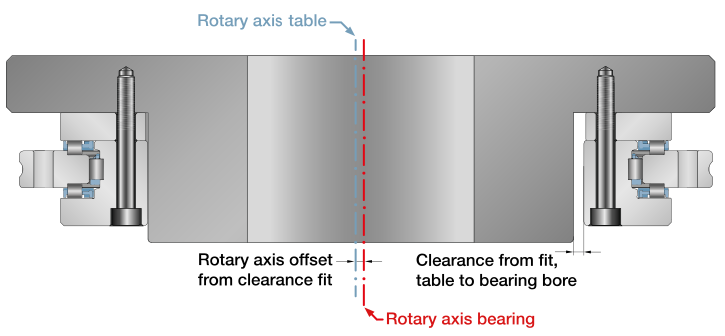
Intentional Clearance (Bewusstes Spiel)
An intentional clearance fit to compensate for ring expansion is feasible, but requires:
- Precise knowledge and control of the temperature of each ring
- Attention to roundness errors and shift of the rotation center
Min. Wall Thickness of the Table
To ensure sufficient rigidity and support, the worktable structure should meet the following minimum wall thickness requirements:
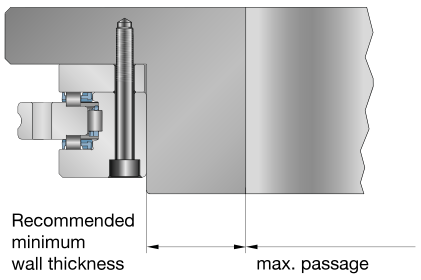
- Min. wall thickness: Minimum thickness of the worktable housing bore wall (mm)
- Max. passage: Maximum permissible passage dimension of the worktable housing bore (mm)
| Bearing Size | Min. Wall Thickness [mm] | Max. Passage [mm] |
|---|---|---|
| AXRY 120-NGS (-SBI) | 19 | 82 |
| AXRY 200-NGS (-SBI) | 22 | 156 |
| AXRY 260-NGS (-SBI) | 26 | 209 |
| AXRY 325-NGS (-SBI) | 27 | 271 |
| AXRY 395-NGS (-SBI) | 27 | 340 |
| AXRY 460-NGS (-SBI) | 30 | 400 |
| AXRY 580-NGS (-SBI) | 36 | 508 |
| AXRY 650-NGS (-SBI) | 45 | 560 |
Related Sections
- Shaft Fit Recommendations - Shaft fit tolerance selection
- Housing Fit Recommendations - Housing fit tolerance selection
- Construction Notes - General design guidelines