Preload
The purpose of bearing preload is to ensure that the bearing can rotate and swivel backlash-free in all load situations during operation. The bearing must be precisely supported here. This firstly requires an adjacent construction with appropriate rigidity and accuracy from the user.
Design Strength
As a result of the applied preload, the bearings deform. The quality of the adjacent construction can prevent these normal settling and adaptation processes from being negatively impacted. All bearings are designed for the conventional applications described in the product chapters; if the installation situation deviates from this, it must be discussed with myonic.
Radial Runout
The radial runout accuracy of the bearings can only be transferred to the machine tool axis if the fits on the rotating connecting parts are appropriate and backlash-free. Clearance fits frequently cause radial runout problems.
Axial Runout Accuracy
In the case of the AXDR / AXCR construction series, the axial runout accuracy always applies to the face opposite the counterbores. Please refer to the product tables for information about the corresponding accuracy requirements for the bearing.
Repeatability
Due to the extremely high manufacturing accuracy, the maximum non-compensable repeat error for deformed, uninstalled bearings is 1.5 μm. For most of the construction series, repeatability is measured during assembly. These values can be requested from myonic using the serial number of the bearing.
Installation Height Tolerance
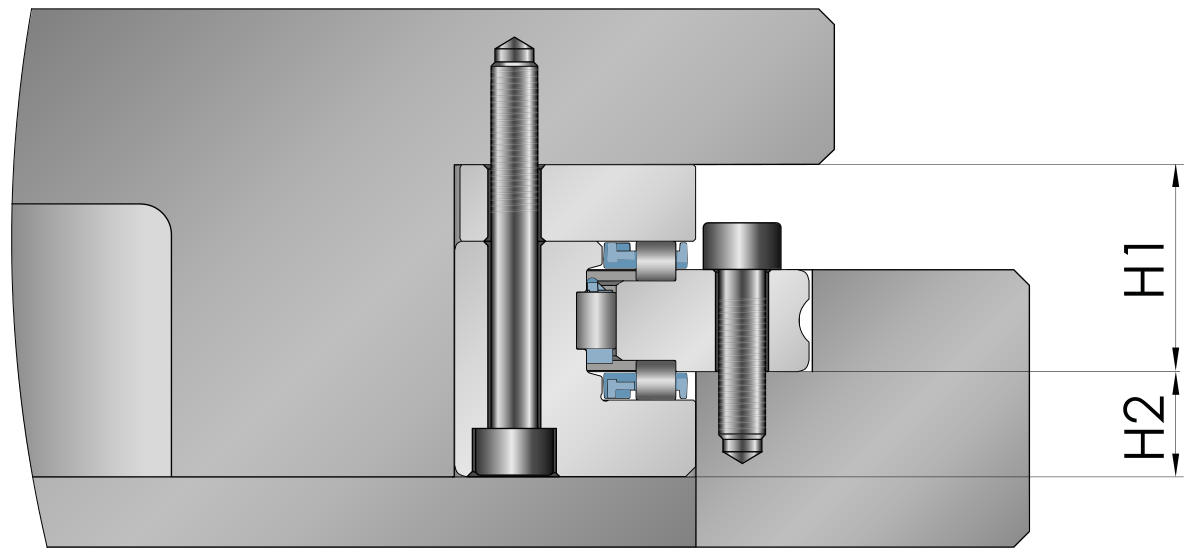
In order to connect drives (e.g. worm gears), or to produce defined sealing gaps, some bearing types have limited tolerances in terms of the construction height. These connection dimensions are shown in the product tables. You can obtain further information or possibilities of tolerance limitations from the myonic application engineering department.
Operating Temperature
All bearing types are suitable for operating temperatures from -30°C to +120°C.
The actual operating temperature of a machine tool axis is influenced by many factors. These include heat from the bearing friction (bearing and lubricant), assembly deformation, additional parts that are dragged along, forces that are applied (masses, cutting forces), as well as external heat sources such as drives. Heat can be dissipated to the environment or via additional cooling. myonic internal test results always refer to bearing and lubrication. More detailed information on operating temperature and influencing factors can be found in the AXRY-NGS product chapter.