Bearing Friction Torque
The bearing friction torque comprises multiple components and is primarily determined by the following factors:
- Bearing type and size
- Applied load
- Operating speed
- Lubricant (grease type and base oil viscosity)
- Quantity and distribution of lubricant
- Operating temperature
Bearing Preload
Lower bearing preload produces less friction, resulting in lower temperatures, and is therefore always suitable for high-speed applications. It must be noted that the bearing preload must always be sufficient to ensure the bearing operates without backlash under load. Higher preload provides greater rigidity but also increases bearing friction.
Viscosity of the Lubricant
Viscosity depends on the operating temperature and, of course, on the selected lubricant. Excessively low viscosity leads to mixed friction, particularly in case of low-speed or intermittent operation. On the other hand, excessive viscosity causes high friction, especially in high-speed applications.
Lubricant Quantity
Excessive lubricant quantity significantly increases bearing friction. myonic cages are designed to absorb as much lubricant as possible and discharge it directly onto the rolling elements during operation. During run-in or relubrication, appropriate run-in cycles must be observed.
Commissioning
For grease lubrication, a run-in cycle must be performed during commissioning to distribute the grease in the bearing. Only after complete distribution can the bearing achieve full functionality. If the run-in cycle is not performed correctly, high friction torque may occur, causing the bearing to overheat and become damaged.
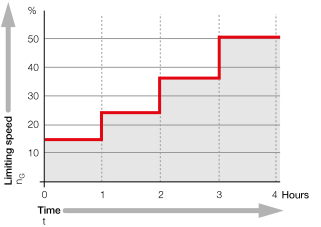
If temperature monitoring is available, the run-in cycle can be adjusted. The maximum ring temperature must not exceed 60°C. If you hear running noises, stop immediately and allow the bearing to cool. For slow-rotating spindles, no run-in cycle is required.
Temperature Limits:
Standard grease is suitable for short-term temperatures up to 120°C.
To ensure a longer grease life, the limit of 80°C should not be exceeded during continuous operation.
Recommended Run-in Cycle
| Step | Duration | Speed Limit (nmax) |
|---|---|---|
| 1 | 1 hour | 10% |
| 2 | 1-2 hours | 20% |
| 3 | 2-3 hours | 35% |
| 4 | 3-4 hours | 50% |
Note: This is a general guideline; specific applications may require adjustments.
Relubrication
Relubrication temporarily increases the lubricant quantity in the bearing until the grease is evenly distributed and the excess amount escapes from the bearing. In the case of large relubrication quantities or unregulated relubrication, a run-in cycle must be performed to distribute the grease in the bearing.
AXRY axial-radial bearings (designs EX, NGX, NGS) and AXCR crossed roller bearings can be relubricated through lubrication grooves in the outer ring. The NGX and NGS bearing types have an additional lubrication connection on the bearing screw support surface of the outer ring. This enables reliable lubricant supply even with a large clearance fit in the housing or when the outer ring is not supported. In addition, we offer the option of lubrication through lubrication grooves in the inner ring with the suffix -SBI.
The AXDR series can be relubricated through two grease nipples installed by the customer on the outer ring.