Efficiency
Efficiency
The natural rolling resistance in the contact areas of rolling elements is an unavoidable loss. Therefore, the actual efficiency ηa is always slightly less than 100%.
Transformation of a torque into an axial force
Transformation of an axial force into a back torque
Factors Determining the Angle of Friction
Factors Determining the Angle of Friction
Manufacturer's Specific Features
- Form of ball tracks - Track geometry of screw and nut
- Manufacturing accuracy - Level of machining precision
- Surface hardness - Hardness of screw and nut
- Surface quality - Surface treatment of ball tracks
- Recirculating system - Ball return design
Users' Operation Data
- Axial load and acceleration - Applied forces and dynamic conditions
- Lubrication - Lubricant type and condition
- Number of rotation - Operating speed
- Mounting accuracy - Alignment of screw and nut
Practical Efficiency and Operating Temperature
Practical Efficiency and Operating Temperature
Under operating conditions, the axial load Fa may be several times the nut preload Fpr. Therefore, the manufacturer's specific features have a significant impact on the actual efficiency ηa. The effect of efficiency on operating temperature can be seen from the chart.
Angle of Friction for AM Ball Screws
After adjusting nut preload and the resulting axial rigidity, the angle of friction ρ for AM ball screws is approximately 0.2 degrees
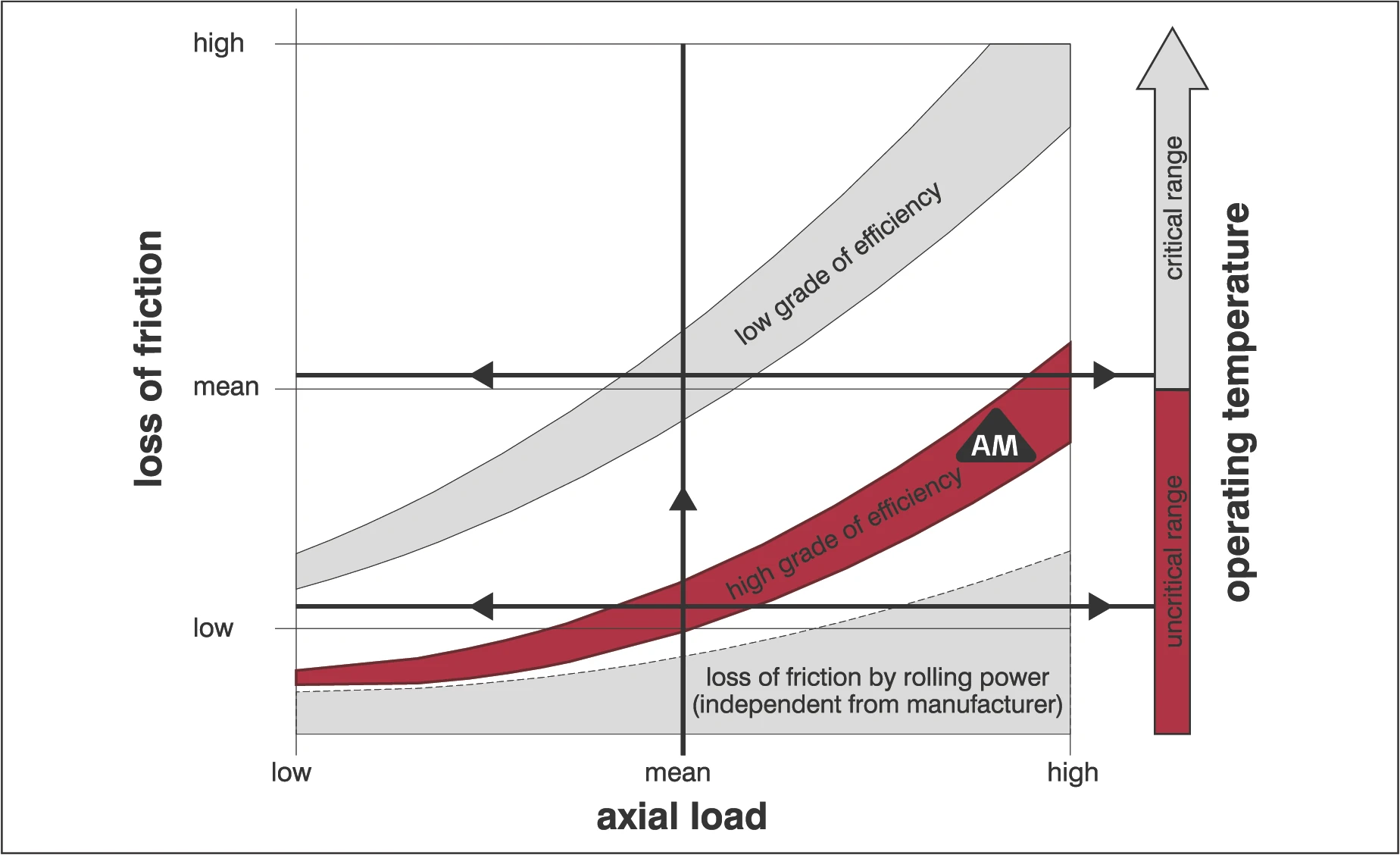
Effect of efficiency on operating temperature
Driving Torque
Driving Torque
Transformation of a torque Ma into an axial force Fa
Transformation of an axial force Fa into a back torque Me