Static Load Rating C0
The static load rating is calculated according to DIN ISO 76. The static load rating C0 is the load at which the Hertzian contact pressure between the rolling elements and the raceways, at the point of maximum load, reaches the following values:
- For roller bearings: 4,000 MPa
- For ball bearings: 4,200 MPa
For rolling bearings, this represents the load limit of the material that produces a permanent deformation of 0.0001 times (0.01%) the rolling element diameter. If the load exceeds the static load rating, the function, noise level and accuracy of the bearing arrangement are adversely affected.
Static Load Safety Factor S0
The calculation of the static load safety factor must be carried out separately for the radial and axial bearing components. To avoid permanent plastic deformation of the bearing, the static load safety factor S0 for machine tool applications should be as follows:
S0 = Static load safety factor
C0 = Static load rating [N]
P0 = Static equivalent bearing load [N]
- S0 ≥ 4: For applications with high precision requirements and high demands on running smoothness
- S0 ≥ 3: For applications with normal demands on running smoothness
- S0 ≥ 2.5: For applications with lower demands on running smoothness and running accuracy
Calculation of the static equivalent bearing load P0:
When the loads Fr and Fa act together:
P0,rad = Fr + 0.26 · Fa (for Fa / Fr ≤ 4.2)
P0,ax = Fa + 3.8 · Fr
Static Limiting Load Diagrams
The static limiting load diagrams are used to:
- Check the selected bearing size under predominantly static loading
- Determine the tilting moment MK that the bearing can support in addition to the axial load
The static limiting load diagrams take into account the static load safety factor S0 ≥ 4 as well as the strength of the screws and bearing rings.
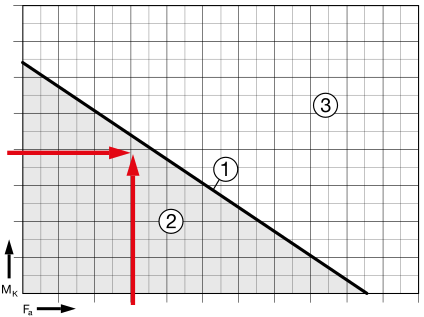
| Example: explanation of the static limiting load diagram | |
|---|---|
| 1 | Bearing / size |
| 2 | Permitted range |
| 3 | Non-permitted range |
| Fa | Axial load [kN] |
| MK | Maximum tilting moment [kNm] |
(Note: this is a general example. For the specific limiting load diagrams and values of each bearing type, please refer to the corresponding product section.)
Dynamic Load Rating C
The dynamic load rating is calculated according to DIN ISO 281. The dynamic load rating C is the load, constant in magnitude and direction, under which a sufficiently large number of identical bearings reaches a nominal life of one million revolutions.
Life Time
The life time is calculated using the following procedures:
- Nominal life L10 according to ISO 281 (million revolutions)
- Nominal life L10h according to ISO 281 (operating hours)

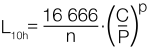
Where:
L10 = Nominal life (million revolutions)
L10h = Nominal life (hours)
C = Dynamic load rating [N]
P = Dynamic equivalent bearing load [N]
p = Life exponent (for roller bearings p = 10/3)
n = Operating speed [min⁻¹]
The extended modified life Lnm is calculated according to DIN ISO 281 Supplement 4 (ISO/TS 16281).
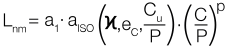
where a1 = 1 (90% probability of survival) and aISO is the life factor that accounts for the operating conditions.
myonic will be glad to carry out these calculations for you. The following information is required for the calculation:
- Application details (drawings, sketches, specifications)
- Workpiece dimensions and weight
- Load cycle details (cutting forces, speeds, operating durations)
Service Life
The service life is the life actually achieved by the bearing. It may deviate significantly from the calculated life. Possible factors that influence the service life include wear or fatigue caused by:
- Deviating operating data
- Misalignment between shaft and housing
- Operating clearance too small or too large
- Contamination
- Insufficient lubrication
- Excessive operating temperature
- Oscillating bearing movement with very small oscillation angles (false brinelling)
- Vibration stress and false brinelling
- Very high impact loads (static overload)
- Pre-damage during assembly
The service life cannot be determined accurately by mathematical methods. The most reliable estimate is obtained by comparison with similar installation cases.