In order to improve the fit conditions between the bearings and the shaft or housing, myonic uses the tolerance group classification of the inner and outer diameters of the bearings.
Note: The classification may result in various measurement groups. The measured groups are specified on the packaging.
Group Classification System
The myonic group classification system divides the bearing inner and outer diameters into multiple precision tolerance groups to achieve an optimal fit with shafts and housings. This classification method enables:
- Improved precision between bearings and mating parts
- Consistent fit conditions
- Reduced clearance variation after installation
- Enhanced overall system performance
Group Combination Matrix
The diagram below shows the complete group combination matrix, covering all combinations of the inner diameter (d) rows and outer diameter (D) columns, together with the matrix regions corresponding to each suffix code.
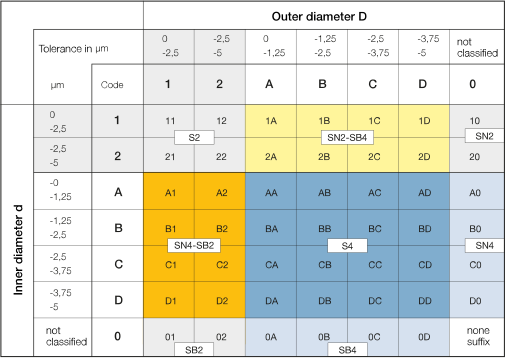
Diagram: Complete group combination matrix (inner diameter d × outer diameter D, with regions annotated for each suffix code)
Suffix Code Examples
The diagram below illustrates examples of group codes corresponding to each suffix code: S4 → AC, S2 → 12, SB2 → 01, SN4 → A0, as well as the use of the "O" symbol (indicating that the diameter is not classified).
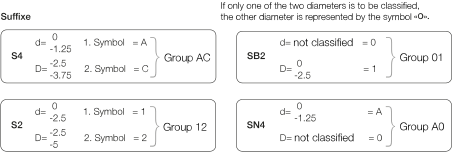
Diagram: Suffix code examples (S4, S2, SB2, SN4 and corresponding group codes)
Group Codes and Tolerance Ranges
The following table lists all group codes and their corresponding tolerance ranges (unit: μm).
Diameter Group Definitions (applicable to both inner diameter d and outer diameter D)
| Group Code | Tolerance Range (μm) | Group Width | Description |
|---|---|---|---|
| 1 | 0 to -2.5 | 2.5 μm | 2.5 μm width group (upper half range) |
| 2 | -2.5 to -5 | 2.5 μm | 2.5 μm width group (lower half range) |
| A | 0 to -1.25 | 1.25 μm | 1.25 μm width group (upper half of group 1) |
| B | -1.25 to -2.5 | 1.25 μm | 1.25 μm width group (lower half of group 1) |
| C | -2.5 to -3.75 | 1.25 μm | 1.25 μm width group (upper half of group 2) |
| D | -3.75 to -5 | 1.25 μm | 1.25 μm width group (lower half of group 2) |
| 0 | Not classified | - | This diameter is not grouped |
Group System Explanation:
- 2.5 μm groups (1, 2): Standard grouping width, suitable for general precision applications
- 1.25 μm groups (A, B, C, D): Ultra-precision grouping, nested within the 2.5 μm groups, for extremely high precision fits
- All tolerance values are negative (0 to -5 μm), conforming to bearing industry standards
Ordering Suffix Codes
The suffix code used when ordering specifies which diameters require classification and the classification precision. The actual group code (such as "AC") is marked on the packaging.
Suffix Codes and Grouping Matrix
| Suffix Code | Inner Diameter (d) Classification | Outer Diameter (D) Classification | Possible Groups | Group Code Examples |
|---|---|---|---|---|
| S4 | 1.25 μm group (A, B, C, D) | 1.25 μm group (A, B, C, D) | 16 | AA, AB, AC, ... DD |
| S2 | 2.5 μm group (1, 2) | 2.5 μm group (1, 2) | 4 | 11, 12, 21, 22 |
| SN4 | 1.25 μm group (A, B, C, D) | Not classified (0) | 4 | A0, B0, C0, D0 |
| SN2 | 2.5 μm group (1, 2) | Not classified (0) | 2 | 10, 20 |
| SB4 | Not classified (0) | 1.25 μm group (A, B, C, D) | 4 | 0A, 0B, 0C, 0D |
| SB2 | Not classified (0) | 2.5 μm group (1, 2) | 2 | 01, 02 |
| SN4-SB2 | 1.25 μm group (A, B, C, D) | 2.5 μm group (1, 2) | 8 | A1, A2, ... D2 |
| SN2-SB4 | 2.5 μm group (1, 2) | 1.25 μm group (A, B, C, D) | 8 | 1A, 1B, ... 2D |
Suffix Code Selection Guide (Internal Reference)
| Application Requirement | Recommended Suffix | Reason |
|---|---|---|
| Ultra-high precision applications (both diameters need precision control) | S4 | Both inner and outer diameters grouped at 1.25 μm, highest precision |
| General precision applications (both diameters need control) | S2 | Both inner and outer diameters grouped at 2.5 μm, best value |
| Only inner diameter precision fit required (shaft fit critical) | SN4 or SN2 | Only inner diameter grouped, outer diameter standard tolerance |
| Only outer diameter precision fit required (housing fit critical) | SB4 or SB2 | Only outer diameter grouped, inner diameter standard tolerance |
| Mixed precision requirements | SN4-SB2 or SN2-SB4 | One diameter high precision, the other standard precision |
Important Notes:
- The actual group code (such as AC, 12, etc.) is marked on the bearing packaging
- Specify the suffix code when ordering (e.g., S4); the specific group code will be visible upon delivery
- "myonic cannot offer any assurance that bearings of one shipment are supplied in one single group."
- Group classification increases manufacturing cost and should be chosen according to actual requirements
- If both diameters are not classified, no suffix code is used
Benefits of Group Classification
| Benefit | Description |
|---|---|
| Precise Fit | By selecting the appropriate measurement group, more precise interference or clearance fits can be achieved |
| Reduced Variation | Narrower tolerance range reduces fit differences between batches |
| Optimized Performance | Ensures bearings operate under optimal conditions, extending service life |
| Simplified Assembly | Standardized measurement groups simplify bearing selection on production lines |
Application Guide
When selecting the appropriate measurement group, consider the following factors:
- Bearing accuracy grade requirements
- Mating part tolerances (shaft and housing)
- Operating conditions (speed, load, temperature)
- Required fit type (interference fit or clearance fit)
For more detailed information on group classification or assistance in selecting the appropriate measurement group, please contact our application engineers.