General
AXRY-EX bearings are double-direction, screw-on precision bearing units ready for installation and intended for highly-rigid applications, for example for rotary tables or milling heads. The bearing absorbs axial and radial forces as well as tilting moments backlash-free.
AXRY-EX bearings are suitable for grease and oil lubrication, and are designed for maximum rigidity. The friction torques of the bearing have been optimised, and the starting torque and running torque are almost identical.
In this way, myonic AXRY-EX bearings fulfil all the requirements for modern highly-dynamic and direct-driven machine axes.
For high-speed applications, the AXRY-NGS design is recommended.
Bearing Structure
AXRY-EX bearings consist of three rings:
- Inner ring
- Outer ring
- Axial washer
The hole inner ring features an appropriate fit. The axial washer is unsupported in the area of the hole. Two axial roller sets and one radial roller set absorb radial and axial forces and tilting moments. All AXRY roller sets are radially and axially equipped with high-performance cages.
Accuracy and Designs
AXRY-EX bearings are supplied in the standard series with dimension tolerances P5 acc. DIN 620. The running tolerances (axial and radial runout) are available in 2 classes: normal and constricted.
For the EX bearings, all variations are available without limitations, including:
- Limitation of the axial and radial runout
- Height tolerances H1/H2
- Design with supported L-section ring AC
The inner ring and the axial washer have the same axial runout properties.
- PL: Axial runout (Planlauffehler) [μm]
- RL: Radial runout (Rundlauffehler) [μm]
Axial and Radial Runout Accuracy
| Designation | Normal PL & RL [μm] | Restricted PL & RL [μm] |
|---|---|---|
| AXRY 50-EX | 2 | 1 |
| AXRY 80-EX | 3 | 1.5 |
| AXRY 100-EX | 3 | 1.5 |
| AXRY 120-EX | 3 | 1.5 |
| AXRY 150-EX | 3 | 1.5 |
Fastening Screws
The completely assembled bearing is held together with fastening screws which are not usually removed.
However, if the fastening screws are removed, they may not be removed until after the bearing has been completely screwed on, and must be replaced with normal screws. Incorrect removal of the fastening screws can cause a decline in the axial/radial runout or the repeatability.
Lubrication
The bearing is first filled with a special grease (without suffix; Li-special soap with a mix of synthetic hydrocarbon oil and mineral oil). This grease is a special easy-running grease with appropriate additives for the operation of preloaded roller bearings.
Most commercially-available greases are not suitable for the operation of axial-radial bearings and generate too much friction in the bearing. For details see the general chapter.
Run-in Cycle
The run-in cycles during initial operation and after relubrication should in particular be observed. Overfilling of the bearing is to be avoided, as excessively high grease quantities generate higher friction heat levels and increasing running torques with faster speeds.
If the swivel axes run slowly, the run-in cycle no longer has to be conducted.
Relubrication
Relubrication takes place radially via lubrication channels in the outer ring, or optionally via the inner ring. For further details on relubrication quantities or cycles, you are welcome to write to sales@eb-system.com.
Preservatives (suffix L-120)
The bearings are only provided with preservation for oil-lubricated applications (suffix L-120). The used corrosion protection oil is compatible and mixable with most greases and oils produced on a mineral basis. Check for compatibility when using synthetic lubricants and other consistency enhancers than lithium (complex) soaps; in case of incompatibility, please consult sales@eb-system.com as to further procedures.
Height Tolerances H1 and H2
Both height dimensions, seen from the normal axial contact area of the outer ring, can be substantially limited.
- H1: refers to the position of the table, for example in order to minimally adjust the labyrinth seal gap against the penetration of coolant from the machining area.
- H2: refers to the adjacent construction under the bearing, for example for adjusting the clearance of a worm gear drive.
The exact tolerances are located in the product tables.
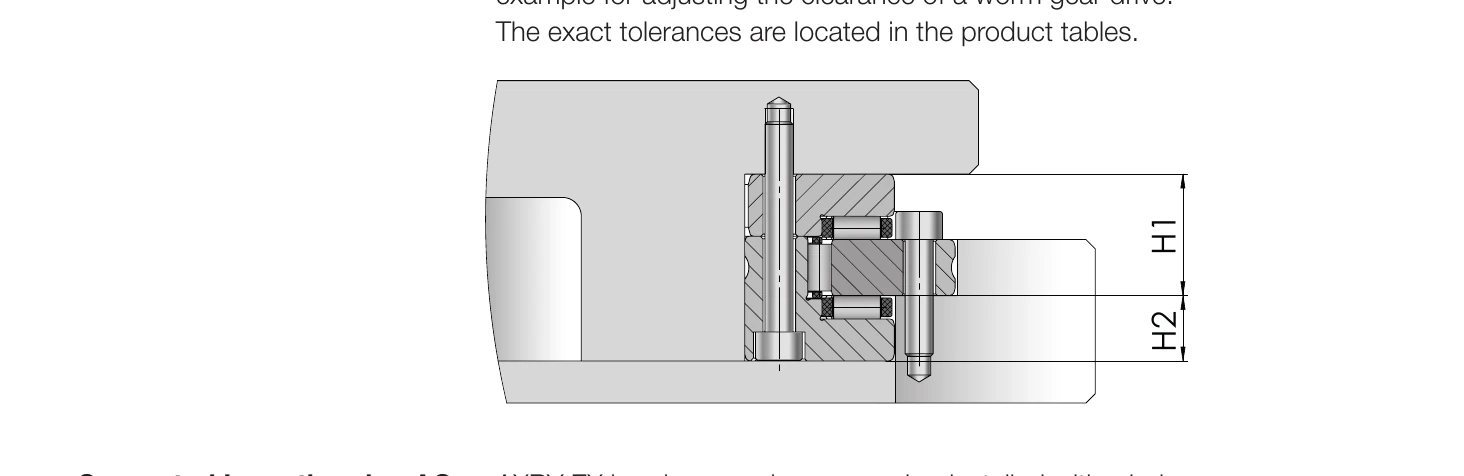
- H1: Table-side height tolerance
- H2: Adjacent-construction-side height tolerance
- ∆H1 Normal: H1 normal tolerance
- ∆H1 Restricted: H1 restricted tolerance (suffix PRR50)
- ∆H2: H2 tolerance
Height Tolerance Overview
| Designation | H1 [mm] | ∆H1 [mm] | H2 [mm] | ∆H2 [mm] | |
|---|---|---|---|---|---|
| Normal | Restricted | ||||
| AXRY 50-EX | 20 | ±0.125 | ±0.025 | 10 | ±0.02 |
| AXRY 80-EX | 23.35 | ±0.150 | ±0.025 | 11.65 | ±0.02 |
| AXRY 100-EX | 25 | ±0.175 | ±0.025 | 13 | ±0.02 |
| AXRY 120-EX | 26 | ±0.175 | ±0.025 | 14 | ±0.02 |
| AXRY 150-EX | 26 | ±0.175 | ±0.03 | 14 | ±0.02 |
Supported L-section Ring AC
AXRY-EX bearings can be installed exposed or with whole-surface support. If the L-section ring (bearing inner ring) is supported across its whole surface by a support ring, the tilting rigidity of the bearing increases by approx. 15 to 20%.
In order to prevent an increase in the bearing friction torque, the bearing preload is adapted (suffix AC). If normally-aligned bearings with supported L-section rings are used, the bearing friction torque increases by 10–20%, and in part more. For further details, see the bearing rigidity chapter.
Design the support ring at least twice as high as the axial washer.
- dSR: Support ring inner diameter [mm]
- DSR max.: Support ring outer diameter, maximum [mm]
- BSR: Support ring width [mm]
- TSR: Evenness/contact area [μm]
Recommended Support Ring Geometry for Maximum Rigidity
| Bearing size | dSR [mm] | DSR max. [mm] | BSR [mm] | TSR [μm] |
|---|---|---|---|---|
| AXRY 50-EX | 51 | 105 | 12 | 3 |
| AXRY 80-EX | 81 | 130 | 15 | 3 |
| AXRY 100-EX | 101 | 161 | 16 | 4 |
| AXRY 120-EX | 121.5 | — | 18 | 4 |
| AXRY 150-EX | 151.5 | 214 | 18 | 5 |
Measuring System
AXRY-EX bearings can be equipped with inductive angle measurement systems, available in incremental and absolute design (as single- or multi-head systems in very different accuracies).
Mounting this system onto the bearing facilitates maximum accuracies through the exploitation of the precision on the bearing ring with minimal concentricity errors to the shaft (table).
See more in the Measuring Systems chapter.
Customer-specific Design Jxxxx (J-number)
myonic produces customer-specific designs which are designated with J and a number (J-number). Such J-numbers can, for example, include:
- Specific, application-related preload values
- Special directives for marking or packaging
- Special lubrication systems
- Changed dimensions/tolerances
- Outer ring rotation design
Limiting Speeds, Temperatures and Friction
The limiting speed nG stated in the dimensions table can be achieved for the selected axial-radial bearing in swivel operation or during short-term continuous operation. In case of prolonged operation in the area of the limiting speed, the bearing increasingly heats up. For high-speed applications such as milling/turning tables, bearings in the AXRY-NGS design are recommended.
Axial-radial bearings in the AXRY-EX series are equipped with cages both in the radial and in the axial part. In this way, the bearings run under full preload with very little friction. Here the starting friction torque is only slightly higher than the friction torque MRL at 5 rpm, which is listed in the product chapter. Therefore, AXRY-EX bearings are especially suitable for highly-dynamic, direct-driven, multi-axis applications.
The friction torque of the bearing is, amongst other things, also influenced by the viscosity and the quantity of the lubricant. The myonic standard grease can be used prealigned within a wide area of application.
- Excessively high lubrication quantities substantially increase the bearing friction.
- Excessively low viscosities can lead to mixed friction.
myonic cages are designed to absorb as high a quantity of lubricant as possible and to emit the lubricant during operation over a prolonged time period directly onto the rollers.
Please adhere to the appropriate run-in cycles during run-in or relubrication. The specifications for the adjacent construction and surrounding parts are to be strictly adhered to.